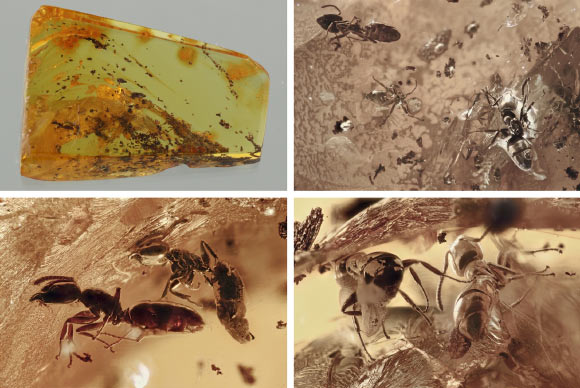
Beyond their aesthetic appeal, fossil inclusions within amber offer profound insights into ancient ecological dynamics, potentially documenting interactions such as parasitism or commensalism between ants and mites, as elucidated by a novel, sophisticated morphological investigation of six samples from Baltic, Dominican, and Burmese amber deposits.
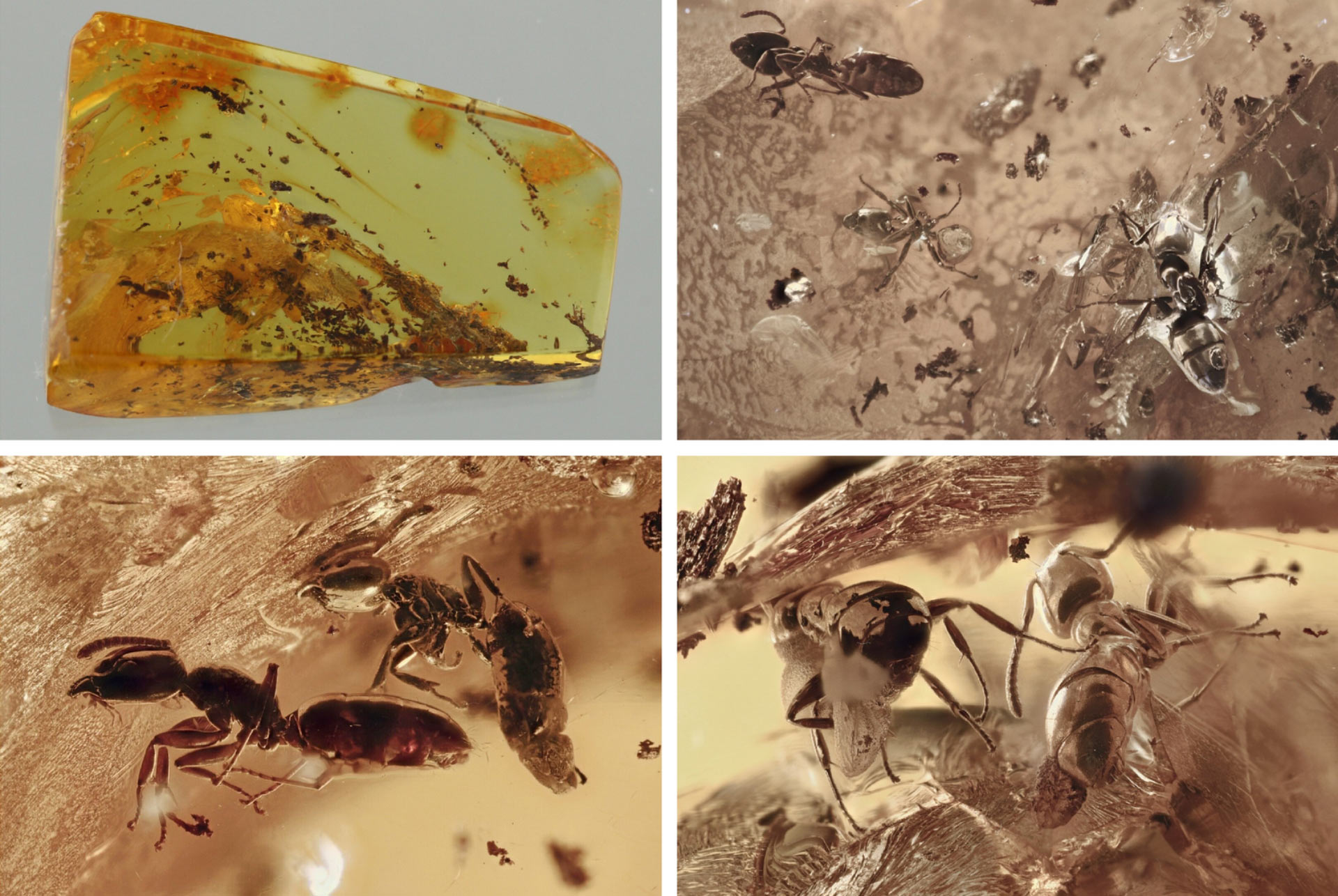
Fossil ant colony preserved in a piece of Baltic amber from Lithuania. Image credit: José de la Fuente & Agustín Estrada-Peña, doi: 10.3389/fevo.2026.1724595.
“The organisms entombed in amber can provide a window into the potential interdependencies that shaped ancient ecosystems,” commented Dr. Jose de la Fuente, a palaeontologist affiliated with the Institute for Game and Wildlife Research.
“The precise identification and detailed morphological characterization of fossil ants found alongside other insect inclusions within amber offer an invaluable glimpse into terrestrial life from millennia past.”
In the current research endeavor, Dr. de la Fuente and his team meticulously examined four amber specimens dating back to the Cretaceous period (approximately 99 million years ago), one from the Eocene epoch (spanning roughly 56 to 34 million years ago), and another from the Oligocene epoch (dating to approximately 34 to 23 million years ago).
These inclusions comprised ancient ants and other arthropods, a phenomenon classified as syninclusion.
“The earliest known ants, first unearthed in Upper Cretaceous strata, are designated as stem ants and lack direct modern descendants; all contemporary ant lineages trace their ancestry to what are known as crown ants,” the palaeontologists elaborated.
“Both of these ant groups, alongside hell ants which are believed to have evolved from stem ants, were present in the six amber samples we scrutinized.”
Employing high-powered microscopy, the researchers meticulously analyzed the specimens to ascertain distinct species identities and to quantify spatial relationships between ants and co-occurring organisms.
Three of the six amber pieces revealed ants in close spatial association with mites.
Within the first sample, a crown ant, a wasp, and two mites were discovered in such proximity to the ant that airborne transport by the ant was hypothesized.
The second piece yielded a stem ant and a spider, whereas the third specimen contained a hell ant, a snail, a millipede, and several insect remains that could not be definitively identified.
The fourth amber sample housed a stem ant and a mite separated by a distance of approximately 4 millimeters.
The fifth inclusion presented three distinct ant species in close proximity to a mite and several termites, augmented by poorly preserved mosquitoes and a winged insect.
In the sixth specimen, scientists identified a stem ant in the company of what is presumed to be a parasitic wasp and a spider. The ant appeared to have been engaged in feeding, positioned against another insect inclusion, which could represent a worm or a larva; however, the absence of any indication of interaction between these two entities led the researchers to consider this association coincidental.
“The instances of ant syninclusions found in closest proximity are more suggestive of behavioral interactions and ecological relationships between these ancient organisms,” stated Dr. de la Fuente.
“The hypothesized ant-mite interactions observed in the fourth specimen could represent one of two potential ecological scenarios.”
“Firstly, a commensal relationship characterized by a specialized, temporary association, wherein mites utilize ants as mobile vectors for dispersal to new environments.”
“Secondly, a parasitic dynamic, where mites derive nourishment from their ant hosts during transit.”
While ants are relatively infrequent inclusions in amber, and specimens containing multiple species are even rarer, existing scientific literature does offer some evidence supporting interspecies interactions between mites and ants, sometimes with mutualistic benefits.
Further investigations employing advanced imaging techniques, such as micro-CT scanning, could potentially identify specialized attachment structures on mites, which would have facilitated their adherence to ants for dispersal.
“To enhance the analytical rigor in deciphering interactions among diverse organisms preserved within fossil amber inclusions, future research should leverage sophisticated imaging methodologies,” Dr. de la Fuente advised.
“Notwithstanding these considerations, the findings reported herein provide compelling evidence regarding the behavior and ecological strategies of ancient insects.”
The research team’s publication is featured in the current issue of the journal Frontiers in Ecology and Evolution.
_____
José de la Fuente & Agustín Estrada-Peña. 2026. Description of fossil amber with ant syninclusions. Front. Ecol. Evol 14; doi: 10.3389/fevo.2026.1724595