For a considerable duration, fossilized skulls have predominantly represented the paleontological record of pachycephalosaurs, commonly known as dome-headed dinosaurs. Conversely, the skeletal remains from beyond the skull of juvenile pachycephalosaurs have remained largely unexamined. Recent discoveries have unveiled the youngest specimen to date of a pachycephalosaur’s body, providing insights into the developmental stages and locomotory habits of these creatures during their nascent months.
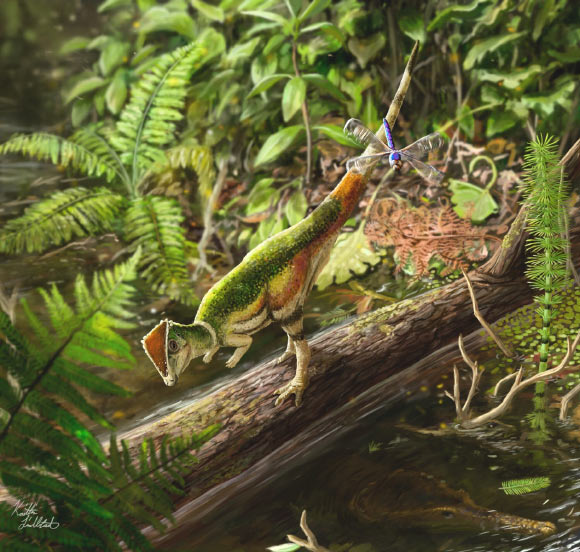
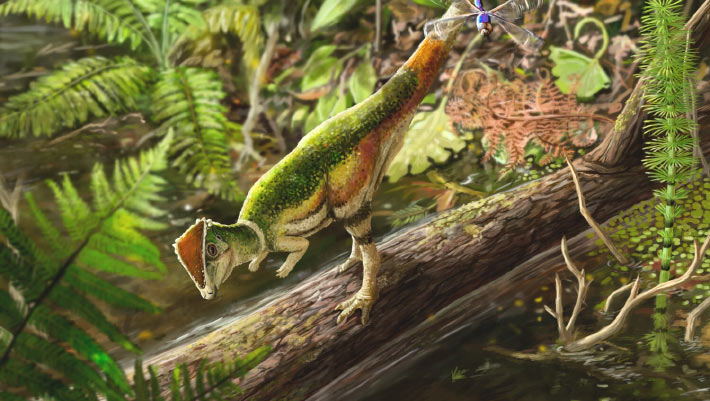
Life reconstruction of the pachycephalosaur individual CMNFV 22039 in an environment typical of the Upper Maastrichtian Frenchman Formation. Image credit: Kaitlin Lindblad.
“The Pachycephalosauria group encompasses primarily diminutive (ranging from 2 to 6 meters in length), bipedal dinosaurs that inhabited Asia and North America during the Santonian through Maastrichtian epochs (spanning 85 to 66 million years ago),” stated Bryan Moore, a paleontologist from Carleton University, along with his research associates.
“A hallmark characteristic of this clade is the fusion of its frontal and parietal bones, resulting in an enlarged cranial dome.”
“In certain instances, adjacent cranial elements become integrated into this structure and are frequently embellished with ossifications, spikes, or other decorative features.”
“Given that the frontoparietal domes constitute the most robustly preserved components of pachycephalosaur skeletons—aside from their teeth—the fossil evidence for these dinosaurs is largely comprised of these partial cranial remnants.”
“Consequently, a substantial portion of our comprehension regarding pachycephalosaur development and evolutionary relationships is derived predominantly from the study of skull morphology.”
Designated as CMNFV 22039, the recently described pachycephalosaur specimen dates back approximately 67 million years, a period corresponding to the Maastrichtian stage of the Late Cretaceous epoch.
This particular fossil was unearthed within the Frenchman Formation, recognized as the most recent of five Maastrichtian formations located in southern Saskatchewan, Canada.
It is highly probable that this dinosaur had not reached its first year of life when it perished, thus representing the youngest pachycephalosaur identified from postcranial fossil evidence.
“Despite its modest dimensions (with an estimated total length of 90 cm, or approximately 3 feet), the skeletal structure exhibits several features that are definitive indicators of Pachycephalosauria,” the paleontologists commented.
The findings suggest that many of the characteristics scientists utilize for the identification of adult pachycephalosaurs were already evident at a very early stage of their life cycle.
Furthermore, these discoveries offer clues about the locomotion of juvenile pachycephalosaurs; in comparison to adult specimens, the hindlimbs of this juvenile were proportionally elongated, pointing towards a more cursorial, or speed-adapted, physique in its early developmental phase.
As these individuals progressed into maturity, their physical frames reportedly transitioned towards the sturdier proportions observed in adult specimens, implying a shift in their mode of locomotion as they increased in size and mass.
“The comparatively elongated hindlimbs of the juvenile, when contrasted with those of adult pachycephalosaurs, indicate a likely negative ontogenetic allometry affecting the hindlimbs,” the researchers noted.
The research team’s findings were formally published on February 26 in the Journal of Vertebrate Paleontology.
_____
Bryan R.S. Moore et al. The ontogenetically youngest known pachycephalosaur (Dinosauria: Ornithischia) postcranium. Journal of Vertebrate Paleontology, published online February 26, 2026; doi: 10.1080/02724634.2026.2616325