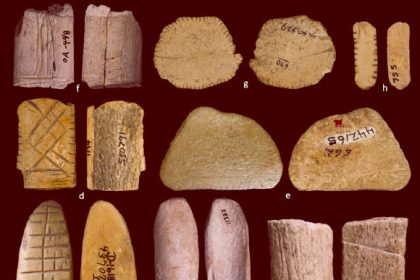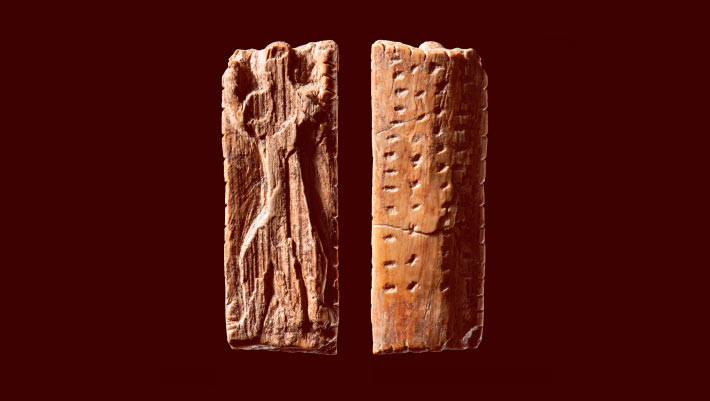
Evidence suggests that early hominids inhabiting Europe approximately 40 millennia ago devised a standardized system of geometric markings. These deliberate, reproducible inscriptions transcended mere adornment, indicating a nascent form of structured communication, as detailed in a recent investigation published this week in the Proceedings of the National Academy of Sciences.
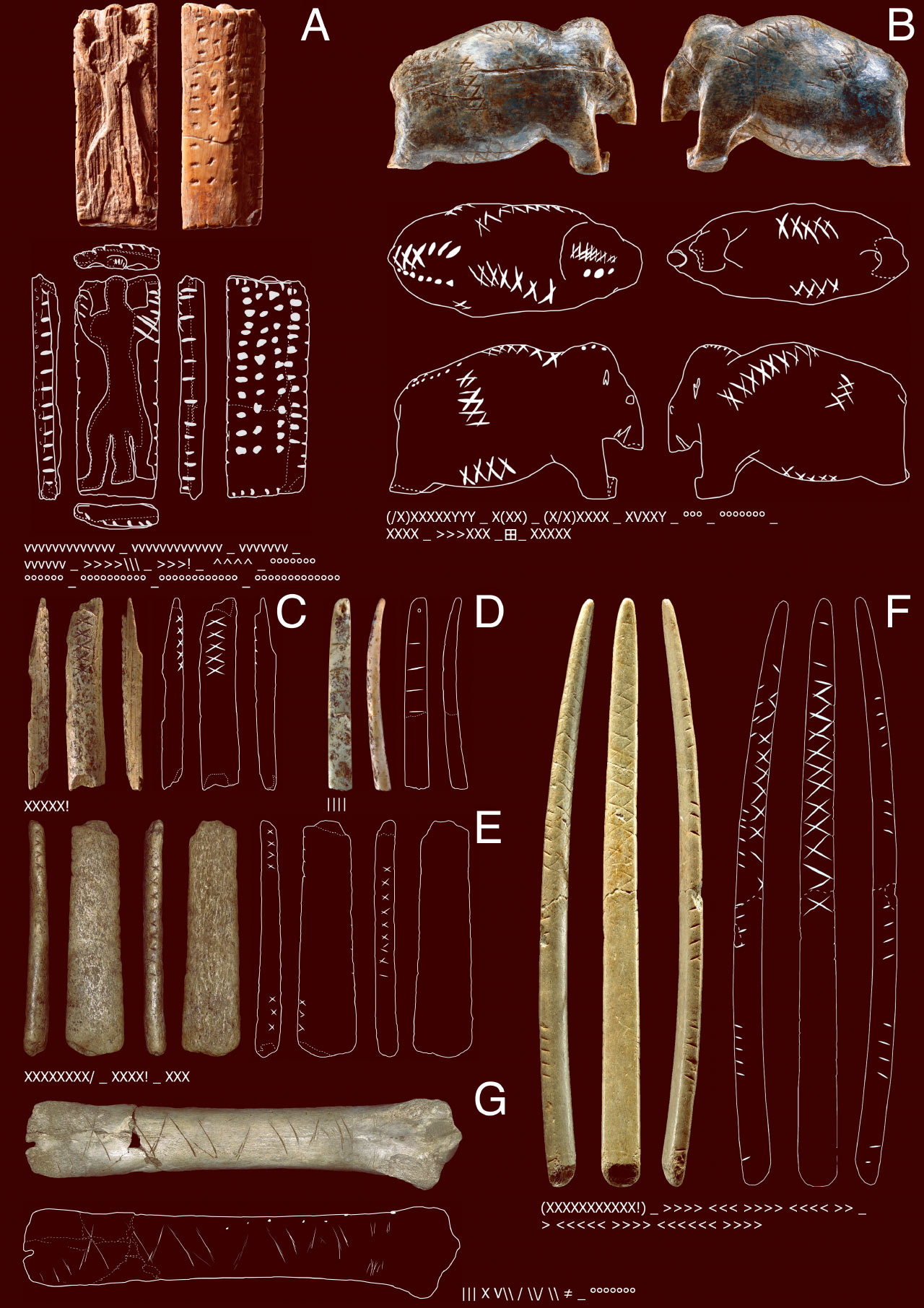
Mobile artifacts bearing geometric signs from the Swabian Aurignacian period. Image courtesy of Christian Bentz & Ewa Dutkiewicz, doi: 10.1073/pnas.2520385123.
“At the dawn of the Upper Paleolithic, around 45,000 years before the present, anatomically modern humans made their appearance in Eastern and Central Europe,” stated Dr. Christian Bentz, a researcher affiliated with Saarland University and the University of Passau, alongside Dr. Ewa Dutkiewicz from the Staatliche Museen zu Berlin.
“During their migrations, they encountered their evolutionary cousins—the Neanderthals.”
“In this epoch of population shifts and turnovers, modern humans generated a profusion of artifacts often referred to as ‘mobile objects,’ comprising tools and figurines fashioned from ivory, bone, or antler.”
“These items are traceable to the earliest phase of the Upper Paleolithic, a period known as the Aurignacian technocomplex.”
“Notably, the Dordogne region in southwestern France, the subterranean cave networks of the Swabian Jura in southwestern Germany, and a concentration of archaeological sites in Belgium have yielded hundreds of objects embellished with patterned sequences of geometric symbols.”
Within this research, the investigators meticulously examined a collection of 260 mobile Aurignacian artifacts recovered from a cluster of cave locations in the Swabian Jura.
These artifacts, crafted from mammoth ivory, bone, and antler, date back to the period between 43,000 and 34,000 years ago.
The assemblage includes implements, ornaments, rudimentary musical instruments, and depictions of fauna and humans.
A significant proportion of these items are adorned with intricate arrangements of dots, lines, crosses, and other geometric forms.
“The inhabitants of these caves, between 43,000 and 34,000 years ago, produced a specialized array of tools for butchering meat, processing animal hides, and fabricating clothing and cords,” the scientific team reported.
“They also developed the earliest known musical instruments—flutes—constructed from bone and ivory.”
Leveraging methodologies from information theory and quantitative linguistics, the authors conducted an analysis of over 3,000 geometric symbols inscribed on these artifacts.
Their assessment encompassed attributes such as the frequency of symbol repetition, the variety of signs employed, and the overall information density within the engraved sequences.
“While numerous hypotheses exist, empirical investigation into the fundamental, quantifiable characteristics of these signs has been notably scarce until this juncture,” Dr. Bentz commented.
The findings revealed a striking divergence: from a statistical standpoint, the Paleolithic symbols bore no resemblance to contemporary written scripts, which typically minimize repetition and maximize information density.
However, a notable congruence was observed with the earliest known tally marks—protocuneiform—utilized in Mesopotamia approximately 5,500 years ago.
This parallel does not imply that Ice Age Europeans engaged in writing. True writing, by definition, represents spoken language. The Aurignacian symbols do not fulfill this criterion.
Rather, the engravings appear to constitute a stable, conventionalized system of symbols—a method for visually encoding and disseminating information, independent of verbal representation.
The placement of these symbols held significance. Figurines, particularly those meticulously carved from ivory, bore more intricate and information-rich sequences compared to utilitarian tools.
Specific sigils were consistently associated with particular subjects: dots were frequently observed on anthropomorphic and felid representations, while crosses were commonly found on depictions of megafauna like mammoths and equids, but conspicuously absent from human figures.
Such discernible patterns suggest the transmission of shared conventions across successive generations.
Over an approximate span of 10,000 years, the researchers ascertained that the structural integrity of this symbolic system remained remarkably consistent—a stark contrast to protocuneiform, which rapidly evolved into fully developed writing with the burgeoning complexity of ancient economies.
“Our analytical results unequivocally demonstrate that these symbol sequences bear no relation to contemporary writing systems, which are designed to represent spoken languages and are characterized by substantial information density,” Dr. Bentz elaborated.
“Conversely, the signs on these archaeological specimens exhibit frequent recurrence—for instance, cross, cross, cross, line, line, line. This pattern of repetition is not a hallmark of spoken language.”
“Nevertheless, our discoveries also indicate that Paleolithic hunter-gatherer societies developed a symbolic framework possessing an information density that is statistically comparable to the earliest protocuneiform tablets from ancient Mesopotamia, which emerged 40,000 years later.”
“The sequences of signs found in protocuneiform script are similarly repetitive, with individual symbols recurring at a comparable rate. In terms of their complexity, these symbol sequences are analogous.”
These revelations bolster a growing consensus among archaeologists that symbolic communication did not manifest abruptly with the advent of writing but rather emerged incrementally, through systems devised for recording numerical data, historical events, or societal knowledge.
It is plausible that some markings served to denote seasonal cycles, hunting intelligence, or ritualistic concepts, although their precise interpretations remain elusive.
“While modern humans possess access to millennia of accumulated information and knowledge transfer that was unavailable to their ancient counterparts, anatomically speaking, Stone Age humans had already attained a developmental stage comparable to that of contemporary humans,” Dr. Dutkiewicz observed.
“This implies that they likely possessed cognitive capacities akin to our own. The capacity to record and convey information to others was paramount for Paleolithic populations. It may have facilitated group coordination and potentially contributed to their survival.”
“They were exceptionally skilled artisans. The portability of these objects is evident; many are sized to fit comfortably within the palm of the hand. This characteristic further aligns these artifacts with the nature of protocuneiform tablets.”
_____
Christian Bentz & Ewa Dutkiewicz. 2026. Humans 40,000 y ago developed a system of conventional signs. PNAS 123 (9): e2520385123; doi: 10.1073/pnas.2520385123