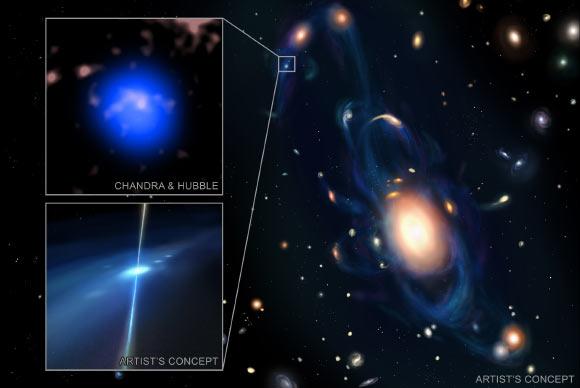
Leveraging data from NASA’s Chandra X-ray Observatory alongside observations from other sophisticated telescopes, astrophysicists have successfully pinpointed the origin of a brief gamma-ray burst event, designated GRB 230906A. This powerful cosmic phenomenon has been traced to a diminutive dwarf galaxy situated within an extensive filament of intergalactic gas. This groundbreaking finding suggests that certain neutron-star mergers – cataclysmic stellar collisions instrumental in synthesizing heavy elements such as gold and platinum – can transpire considerably beyond the luminous cores of galaxies. Such an occurrence could elucidate the mystery of why some gamma-ray bursts appear devoid of any discernible host galaxy.

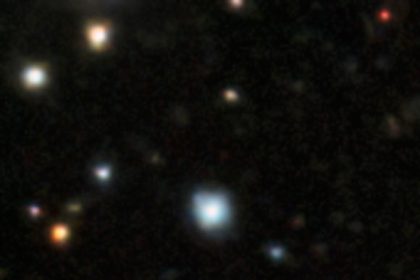
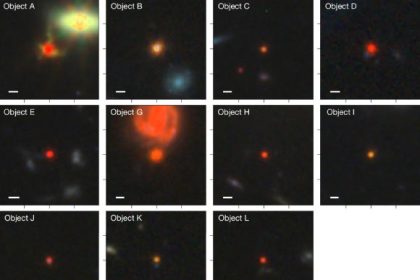
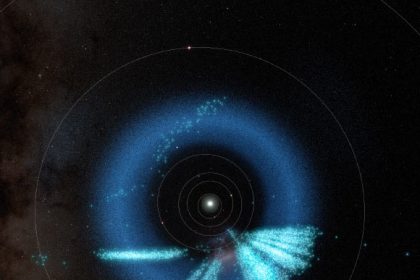
GRB 230906A occurred in a tiny galaxy in a stream of gas located about 4.7 billion light-years from Earth. Image credit: NASA / CXC / Penn State Univ / S. Dichiara / ESA / STScI / ERC BHianca 2026 / Fortuna and Dichiara, CC BY-NC-SA 4.0 / SAO / P. Edmonds.
Neutron stars represent the dense stellar remnants left behind when stars substantially more massive than our Sun exhaust their nuclear fuel, undergo gravitational collapse, and subsequently explode in a supernova.
These celestial bodies, though diminutive, possess a mass exceeding that of the Sun, imbuing them with extraordinary density.
Astrophysicists regard them as some of the most extreme and formidable entities within the cosmos.
In recent years, observational data has primarily documented mergers involving two neutron stars within moderately sized or large galactic structures.
However, this most recent revelation indicates that a neutron star collision may indeed take place within an exceptionally small galaxy.
“The localization of this neutron star collision is a transformative discovery,” remarked Dr. Simone Dichiara, an astrophysicist affiliated with Penn State University.
“It holds the potential to provide solutions to not just one, but two significant enigmas in the field of astrophysics.”
The first profound question that the unprecedented environment of this neutron star collision may help to resolve pertains to the observation that gamma-ray bursts, which can be instigated by the coalescence of two neutron stars, are not consistently observed emanating from galactic cores, or indeed any galaxy at all.
The second scientific quandary that this finding could potentially address concerns the origin of elements like gold and platinum, which have been detected in stars situated at considerable distances from galactic centers.
This particular neutron star collision is situated in an unanticipated location within a minute galaxy, approximately 4.7 billion light-years distant, and is embedded within a vast expanse of gas stretching over 600,000 light-years.
This gaseous filament is presumed to have originated from the collision of a galactic cluster hundreds of millions of years ago, which effectively stripped interstellar material from the galaxies, dispersing it into intergalactic space.
“We’ve essentially observed a merger occurring within another merger,” stated Dr. Eleonora Troja, an astrophysicist at the University of Rome.
“The galactic collision initiated a wave of star formation that, over a span of hundreds of millions of years, culminated in the genesis and eventual collision of these neutron stars.”
To detect the GRB 230906A event, which occurred on September 6, 2023, researchers required the coordinated efforts of several NASA observatories, including the Chandra X-ray Observatory, the Fermi Gamma-ray Space Telescope, the Neil Gehrels Swift Observatory, and the Hubble Space Telescope.
The Fermi telescope first identified the neutron star collision by capturing its characteristic gamma-ray burst signature.
Following the derivation of a preliminary localization for the Fermi source utilizing the InterPlanetary Network, the sharp observational capabilities of Chandra, Swift, and Hubble were then employed to precisely pinpoint the object’s location.
NASA’s missions constitute an integral component of a burgeoning global network dedicated to monitoring cosmic transient events and unraveling the fundamental workings of the Universe.
“Chandra’s exceptional X-ray localization capabilities were indispensable for this investigation,” commented Dr. Brendan O’Connor, a postdoctoral researcher at Carnegie Mellon University.
“Without this precise positional data, we would have been unable to definitively link the burst to any specific celestial source.”
“Furthermore, once Chandra indicated the exact region to examine, Hubble’s remarkable sensitivity enabled the identification of the exceedingly faint, minuscule galaxy at that precise coordinate.”
“This discovery was only made possible by meticulously assembling all the disparate pieces of evidence.”
This finding offers a potential explanation for why certain gamma-ray bursts are observed without any discernible host galaxies.
The implications of this discovery suggest that some host galaxies may be so extraordinarily small and faint that they evade detection in conventional optical light imagery obtained from ground-based observatories.
The unusual spatial distribution of GRB 230906A may also contribute to understanding how astronomers have detected elements like gold and platinum in stars situated at considerable distances from galactic centers.
Such stars are typically anticipated to be more ancient and to have formed from gas that had insufficient time to be enriched with heavy elements originating from supernova explosions.
Through a complex sequence of nuclear reactions, the collision of two neutron stars can indeed synthesize heavy elements such as gold and platinum, a phenomenon comprehensively documented in a previously observed merger event in 2017.
Cosmic events analogous to GRB 230906A could be responsible for the production of these elements and their subsequent dispersal throughout the outer regions of galaxies, eventually becoming incorporated into future stellar generations.
An alternative hypothesis posits that the explosion is originating from a much more distant galaxy positioned behind the observed galactic group.
“We consider this alternative explanation less plausible than the hypothesis involving the tiny galaxy,” the researchers stated.
This significant discovery is detailed in a publication featured in the Astrophysical Journal Letters.
_____
S. Dichiara et al. 2026. A Merger within a Merger: Chandra Pinpoints the Short GRB 230906A in a Peculiar Environment. ApJL 999, L42; doi: 10.3847/2041-8213/ae2a2f