Envision capturing a solitary raindrop and comprehending its origin from a cosmic tempest situated at the farthest reaches of the Universe.
This scenario mirrors the magnitude of an exceptional occurrence recorded on February 13, 2023. A specialized detector, submerged deep within the Mediterranean Sea, identified the passage of an entity of almost unfathomable energy. This entity, a neutrino, possessed an energy level of approximately 220 PeV, shattering the previous record by a factor exceeding ten.
Neutrinos are often referred to as the cosmic spectral particles. They possess negligible mass, exhibit no electrical charge, and interact so infinitesimally with conventional matter that billions would have traversed your being during the perusal of this text without any discernible awareness.
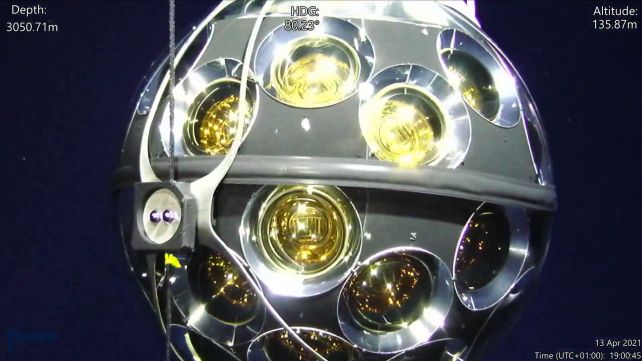
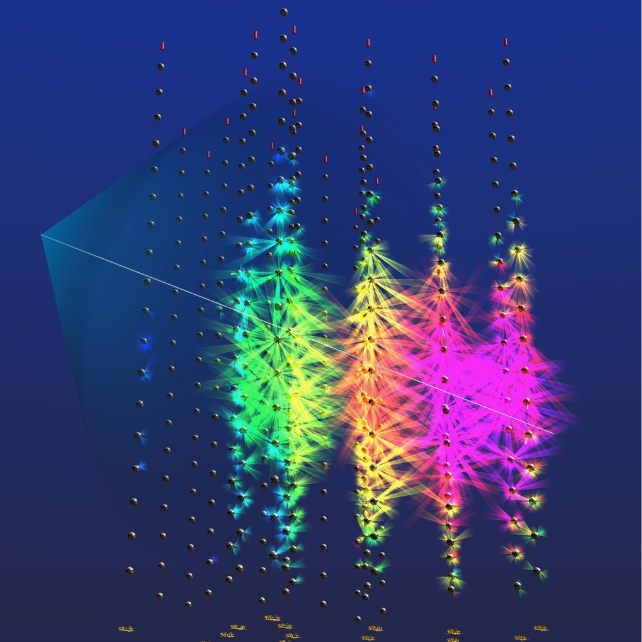
The detection of even a single neutrino at such extreme energy levels necessitates monumental endeavors. This is precisely the rationale behind the existence of the KM3NeT/ARCA detector. Anchored to the seabed off the coast of Sicily, it leverages the Mediterranean Sea itself as its primary medium for observation.
The recorded signal profoundly arrested the attention of the scientific community. None of the established catalogs of known phenomena provided a satisfactory explanation for a particle possessing such exceptional energy.
Consequently, the KM3NeT consortium adopted a methodical approach, akin to that of astute investigators. They meticulously retraced the evidence, constructing sophisticated simulations and rigorously testing various hypotheses until a conclusive match was identified.
Their primary hypothesis, detailed in a recent publication within the Journal of Cosmology and Astroparticle Physics, implicates a category of celestial bodies known as blazars.
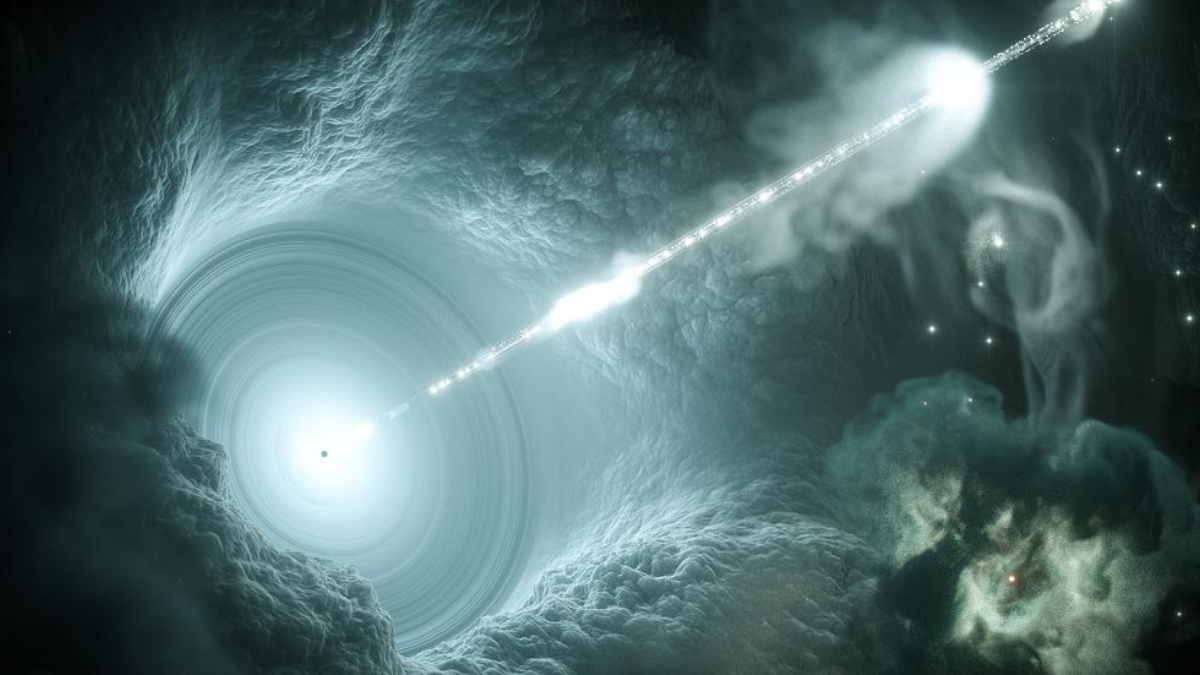
A blazar constitutes an active galactic nucleus, essentially a galaxy featuring a supermassive black hole at its core. This black hole actively accretes surrounding matter, expelling a relativistic jet of plasma at velocities approaching the speed of light.
The distinctive characteristic of blazars lies in their orientation; the emitted jet is aligned almost directly towards our observational perspective, rendering them some of the most luminous and extraordinary celestial objects observable.
The research team meticulously generated simulations of a representative population of blazars. They then computed the predicted neutrino flux that such a population would emanate. These projections were subsequently cross-referenced with empirical observations, not solely from KM3NeT but also from IceCube situated in Antarctica and the Fermi Gamma-ray Space Telescope.
Crucially, the analysis also incorporated a thorough examination of what these instruments had *not* detected. The absence of analogous ultra-high-energy neutrino events in other observational datasets imposes stringent limitations on any proposed explanatory framework, a criterion effectively met by the blazar model.
A significant piece of evidence suggests a departure from a singular, cataclysmic event. When extraordinary phenomena occur in deep space, such as explosive events or intense flares, they typically generate a simultaneous emission of radiation across multiple electromagnetic spectra.
In the case of the 2023 event, no such readily observable electromagnetic counterpart was identified. This observation lends credence to an explanation involving a diffuse background emission, rather than an isolated object exhibiting anomalous behavior. Instead, it suggests a collective contribution from numerous sources, generating a sustained stream of extreme-energy particles, one of which coincidentally arrived at the precise moment of detection.
At the time the record-breaking neutrino was detected, the KM3NeT facility was operating with merely 21 detection lines, representing approximately 10 percent of its eventual full operational capacity. With the complete detector scheduled for deployment and anticipating years of accumulated data, the research team anticipates the realization of significantly more robust analytical capabilities in the future.
Presently, blazars remain the foremost implicated entities. Should it be definitively established that they possess the capacity to accelerate particles to such prodigious energies, this would necessitate a fundamental revision of our current understanding of the Universe’s most powerful cosmic engines.
This narrative was initially disseminated by Universe Today. Access the original account here.