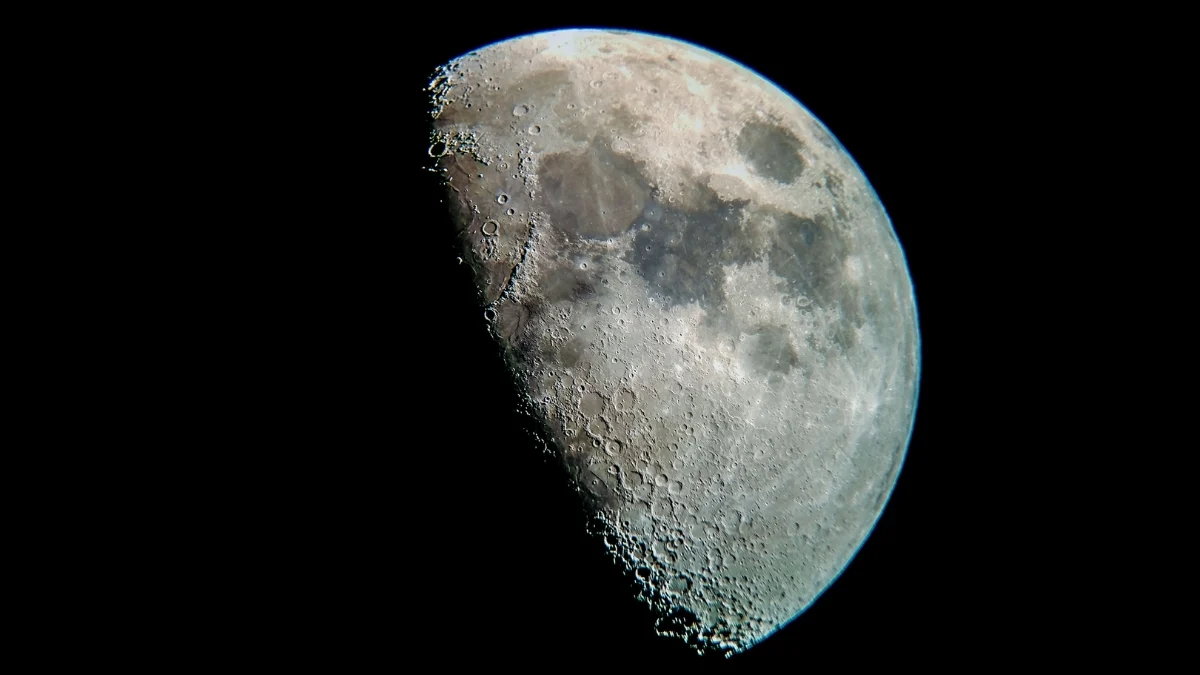
A period of fifty years has elapsed since the detachment of NASA’s Apollo 17 lunar module from our Moon’s northeast quadrant, yet planetary geologists continue to grapple with an incomplete understanding of our satellite’s inception and developmental timeline.
There exists a consensus that a substantial celestial body, designated by lunar researchers as Theia, played a pivotal role, likely colliding with our planet approximately 4.51 billion years ago.
Current estimations for Theia’s magnitude span from an object the size of a nascent Mercury to a celestial entity roughly equivalent to half the mass of contemporary Earth.
Indeed, the most recent hydrodynamic simulations suggest that the hypothesis of a more substantial impactor provides a more compelling explanation for the observed chemical parallels between lunar samples retrieved by the Apollo missions and the olivine-rich volcanic basalts found on Earth.
The profound repercussions of this cataclysmic impact fundamentally reshaped our planet’s trajectory, as articulated by Wim van Westrenen, a lunar and planetary scientist affiliated with Vrije Universiteit Amsterdam, during a recent in-person discourse at his office.
Following such a colossal impact event, the nascent Moon existed as a molten sphere of magma, incandescent at temperatures reaching thousands of degrees.
In its initial state, it was not yet solid rock, necessitating a cooling phase prior to the formation of minerals amenable to dating, as explained by van Westrenen. He posits that the critical inquiry revolves around the temporal duration required for mineral genesis post-impact.
As van Westrenen readily acknowledges, establishing this timeframe presents considerable challenges.
Notwithstanding these difficulties, lunar scientists continue to glean significant insights from the Apollo-acquired rock specimens.
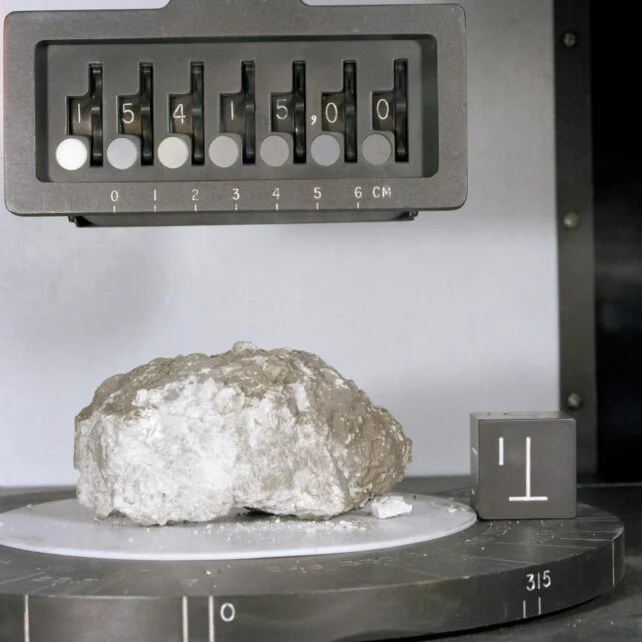
Among the most renowned Apollo samples is the Genesis Rock, unearthed in 1971 by Apollo 15 astronauts. This specimen, dating back 4.46 billion years, is predominantly composed of the mineral plagioclase, which, owing to its low density, tends to ascend to the upper strata of molten magma.
Van Westrenen elaborates that a vast volume of magma is required to generate substantial quantities of this lightweight material, which then coalesces at the surface. This, he suggests, offers the most plausible mechanism for the formation of such light-colored rocks, including the Genesis Rock.
The distinctive white hue of plagioclase, observable when viewing the Moon, is attributed to the light reflection from plagioclase crystals.
The presence of an entire celestial body coated in plagioclase implies that we are, in essence, observing the solidified upper crust of a vast, ancient magma reservoir, according to van Westrenen.
Van Westrenen’s laboratory is dedicated to replicating the extreme pressures and temperatures characteristic of the Moon’s interior, aiming to elucidate the intricacies of lunar geological evolution.
“Our laboratory was the first to conduct a comprehensive experimental investigation into the solidification process of a deep lunar magma ocean and the chronological sequence of mineral formation,” van Westrenen states.
“We surmise that the entirety of the Moon was in a molten state, with a magma layer extending 1,700 kilometers deep, reaching the very core,” he elaborates.
Within the laboratory setting, van Westrenen and his collaborators employ resistive heating techniques, channeling electrical currents through graphite to elevate small volumes of material, measuring mere cubic millimeters, to temperatures exceeding 1,700 °C (3,092 °F). This temperature is approximately five times that achievable with a standard oven.
Furthermore, the facility is capable of generating pressures equivalent to 250,000 Earth atmospheres.
In stark contrast, the maximum internal pressure of the Moon is estimated to be around 50,000 Earth atmospheres, thereby enabling researchers to effectively simulate conditions at the Moon’s core within a laboratory environment.
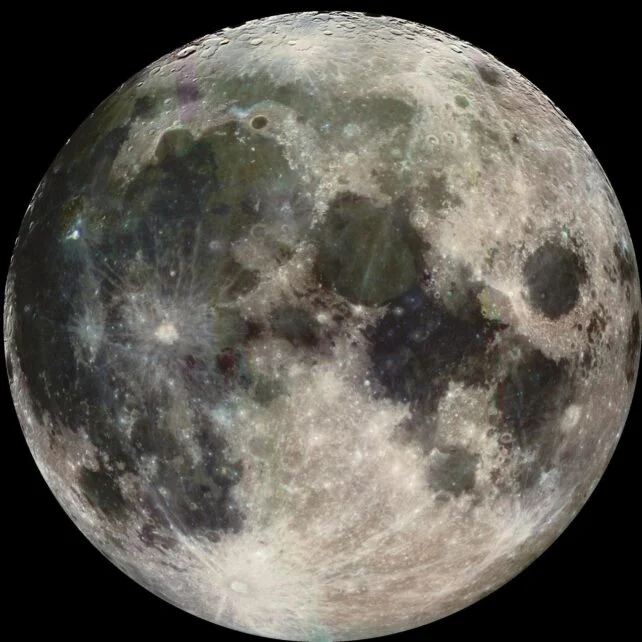
Despite these advancements, a significant challenge in comprehending the formation of the Earth-Moon system lies in the discrepancy between hydrodynamic numerical simulations, which accurately reproduce the current physical attributes of the system, and their inability to account for the observed chemical compositions of the celestial bodies involved.
“All conventional simulation models predict that the Moon should exhibit a chemical composition vastly different from what we currently observe,” van Westrenen remarks.
“The geological samples from the Moon bear a much closer resemblance to terrestrial materials than model predictions suggest,” he asserts.
Regarding the Scale of the Lunar Formation Impactor?
The prevailing hypothesis now posits one of two scenarios: either Earth was nearing completion in its formation, and the Moon resulted from a comparatively small, Mercury-sized impactor striking our planet with considerable velocity and at a high angle.
Alternatively, at that juncture, Earth’s formation was only halfway complete.
“Consequently, an additional half-Earth mass would have been required to attain Earth’s present size,” van Westrenen explains.
Under this second scenario, the Moon would have coalesced from a limited quantity of thoroughly mixed debris originating from both Theia and the nascent Earth, subsequently entering orbit around the now-complete terrestrial planet.
Following the impact, it is theorized that lighter silicate materials coalesced to form the Moon, while denser components contributed to Earth’s mass and consequently its extensive, iron-rich core.
“While this remains a valid tenet, the established models, which are now a quarter-century old, infer that the majority of silicate rocks originated from Theia, rather than from Earth,” van Westrenen clarifies.
“What factor could lead to the Moon being predominantly composed of Earth-like material?”
“For substantial lunar formation to occur in accordance with traditional giant impact models, Theia would have needed to impact Earth in a glancing manner, with a portion of Theia missing Earth,” van Westrenen posits.
“Half of it would collide with Earth’s flank, while the remainder would ostensibly veer past and enter orbit around the proto-Earth, ultimately forming the Moon,” he elaborates.
“However, this proposed sequence suggests that the Moon should primarily consist of material from the Theia impactor. This contradicts current geological findings.”
Theia would have necessarily originated from a different region within the solar system, implying a distinct chemical composition from Earth.
Yet, Earth and the Moon exhibit a perplexing degree of chemical similarity.
The Conclusive Assessment?
“The exact process of lunar origin remains unresolved, despite human presence on its surface decades ago,” van Westrenen concludes.
“While the Moon is visible to all, the profound connection between its formation and the history of our own planet is not universally recognized,” he observes.
This narrative was originally disseminated by Universe Today. Access the original publication.