

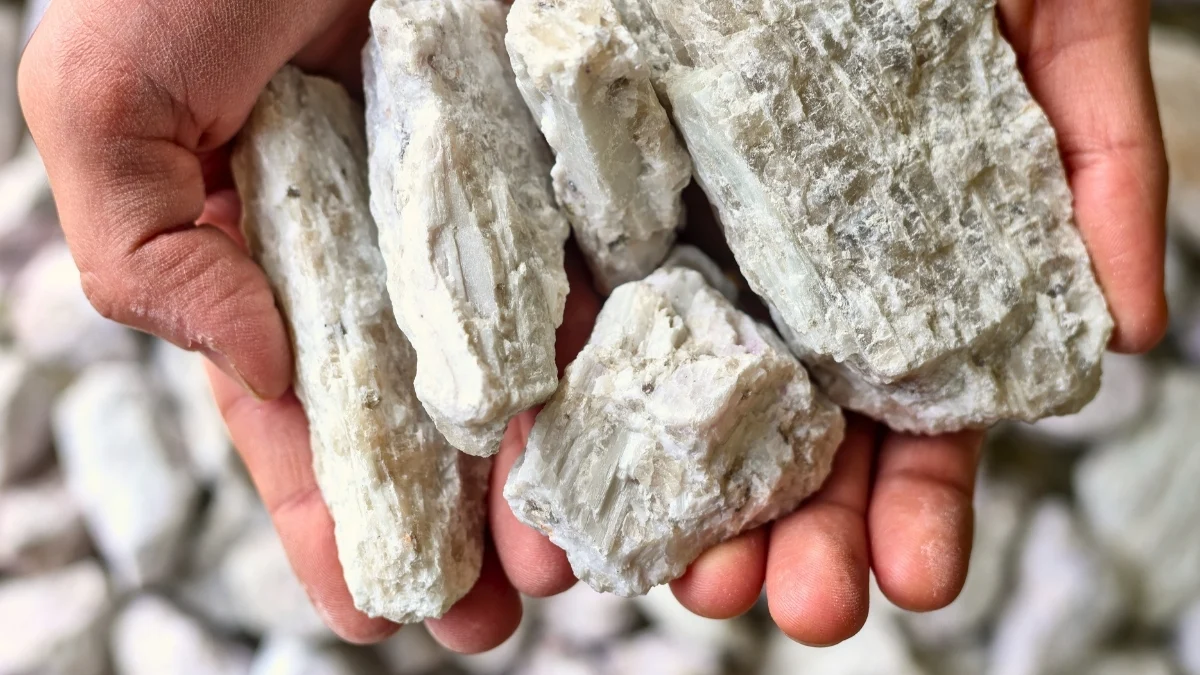
An estimated 330 years of the world’s lithium supply could potentially lie dormant beneath the Appalachian Mountains, a prominent geological feature traversing the eastern United States.
Data from a recent investigation by the US Geological Survey indicates that the Appalachians might harbor approximately 2.3 million metric tons (equivalent to 2.5 million US tons) of extractable lithium oxide, intricately contained within pegmatites. These are granular, granite-like rocks formed during the slow cooling and crystallization of water-rich magma deep within the Earth’s crust.
“This research underscores the considerable lithium reserves within the Appalachians, sufficient to address the nation’s escalating requirements. This represents a significant boost to US mineral security, particularly as global lithium demand experiences a rapid upswing,” stated Ned Mamula, Director of the US Geological Survey (USGS).
Consequently, a comprehensive mapping of domestic mineral resources could potentially mitigate the country’s recent dependence on imported lithium.

“Decades ago, the United States held a leading position in global lithium production, and this study highlights the substantial potential for us to regain our mineral self-sufficiency,” Mamula further commented.
Lithium, a soft and silvery metal, is characterized as the lightest among metals and the least dense of all solid elements. It ranks among the most ancient elements known, with trace quantities originating from the Big Bang event.
Crucially, it serves as the fundamental active component in lithium-ion batteries, which account for an overwhelming 87 percent of worldwide lithium consumption.
These rechargeable power sources are integral to the functioning of our most vital devices, including smartphones, portable computers, electric vehicles, and large-scale energy storage systems, rendering lithium indispensable for the advancement of clean energy technologies.

In alignment with this trend, projections from the International Energy Agency (IEA) indicate that lithium demand is expected to escalate dramatically, potentially more than 40-fold by the year 2040.
In response to these evolving needs, the USGS has been entrusted with the critical task of evaluating significant mineral deposits across the United States.
Accordingly, as detailed in their recent publication, USGS scientists employed a multifaceted approach to ascertain the scale and availability of yet-to-be-discovered lithium-bearing pegmatite formations within the Appalachian region of the US.
Initially, the research team collated publicly accessible geological and geochemical information, including mineral distribution maps, to identify areas designated as “permissive tracts”—regions with a higher likelihood of containing lithium deposits.
Subsequently, the potential volume of lithium within these prospective, undiscovered reserves was quantified using the Delphi Method. This method involves a structured communication process with a panel of over 20 USGS geoscientists, conducted over a two-day period in July 2024.
Furthermore, the researchers extrapolated the quality and quantity of the lithium-rich ore by referencing data from known lithium deposits globally, which had been previously characterized through methodologies such as mineral inventory assessments.
To conclude, the research team initiated 20,000 probabilistic simulations, drawing upon the aforementioned data, to establish the most credible lithium distribution scenarios. An economic assessment was then applied to determine the feasibility of extracting these lithium resources.
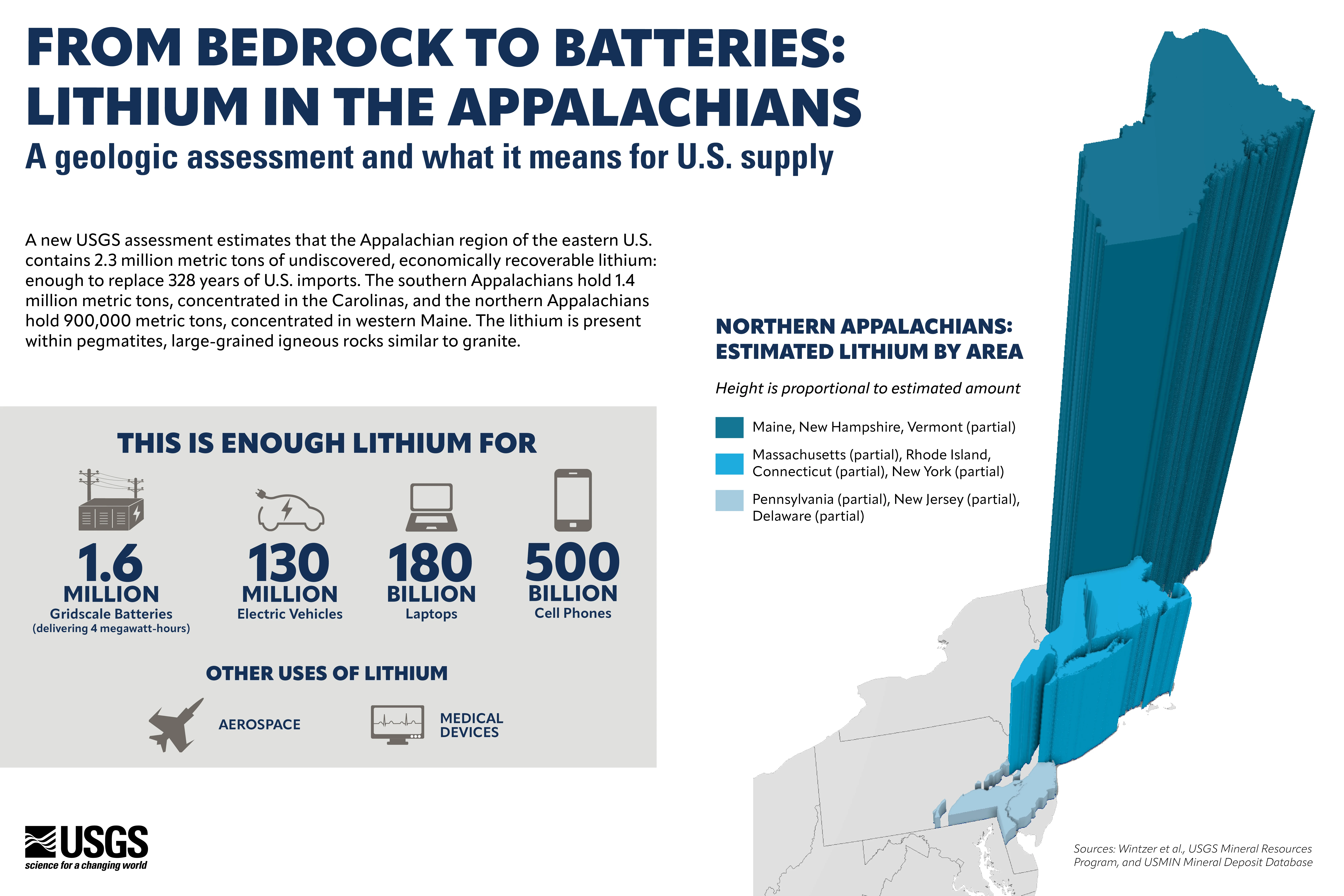
The study suggests that approximately 900,000 metric tons of lithium oxide could be economically extracted from deposits in the northern Appalachian region, with Maine, New Hampshire, and portions of Vermont identified as the most promising locations.
An additional 1.43 million metric tons are estimated to be extractable in the southern Appalachian region, primarily concentrated in the Carolinas.
Collectively, the researchers assert that these substantial reserves could fulfill the United States’ lithium requirements for an impressive 328 years, assuming current consumption and import rates observed in 2025.
For comparative insight, this quantity could equip every individual on the planet with 60 smartphones. It could also sustain the global supply of laptops for a millennium—though by that distant future, computational devices might be more intrinsically linked to the human mind or integrated within our biological systems.
These presently undeveloped reserves are not the sole significant lithium deposits found within the US.
In an independent development, a separate report recently detailed a substantial lithium concentration circulating within the saline waters of an ancient limestone aquifer situated beneath Arkansas, a geological formation known as the Smackover Formation.
However, the practical extraction of these particular reserves may present greater challenges.
Should this lithium eventually transition from its subterranean location beneath the northern Appalachians to power our smartphones, it will have completed an extraordinary journey that commenced over 300 million years ago with the formation of the supercontinent Pangea.
This research findings were officially published in the esteemed journal Natural Resources Research.




.jpeg)