A resplendent galaxy, adorned with striking dark nebulae and vibrant clusters of stellar nurseries, possesses more than superficial beauty.
The M77 galaxy, also cataloged as NGC 1068 and colloquially known as the Squid Galaxy, serves as the quintessential example of its cosmic classification, harboring a prodigious black hole at its nucleus that actively radiates energy.
Given its proximity to our own Milky Way galaxy—approximately 35 million light-years distant—and its luminous nature, presenting its full disc towards our vantage point, it functions as an exceptional observatory for dissecting the turbulent phenomena within an active galactic nucleus.
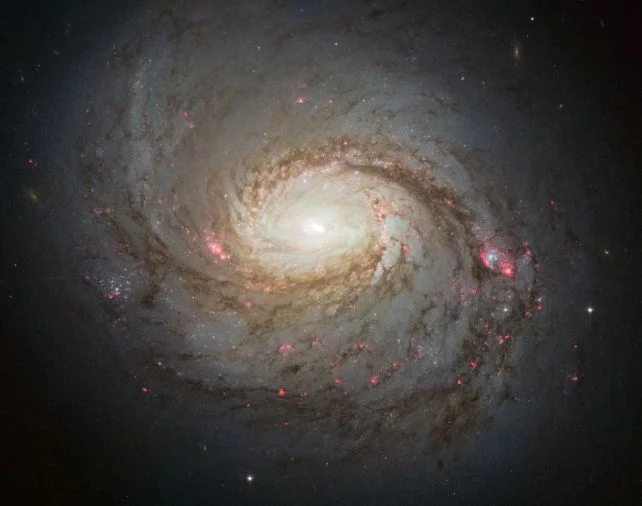
Conveniently, this observational objective aligns perfectly with the design specifications of the James Webb Space Telescope (JWST).
Infrared radiation possesses the unique advantage of penetrating or dispersing minimally through cosmic dust, unlike shorter electromagnetic wavelengths. Consequently, through novel near-infrared (NIRCam) and mid-infrared (MIRI) observations, JWST has illuminated aspects of the Squid Galaxy previously undetectable across optical, ultraviolet, or even radio spectra.
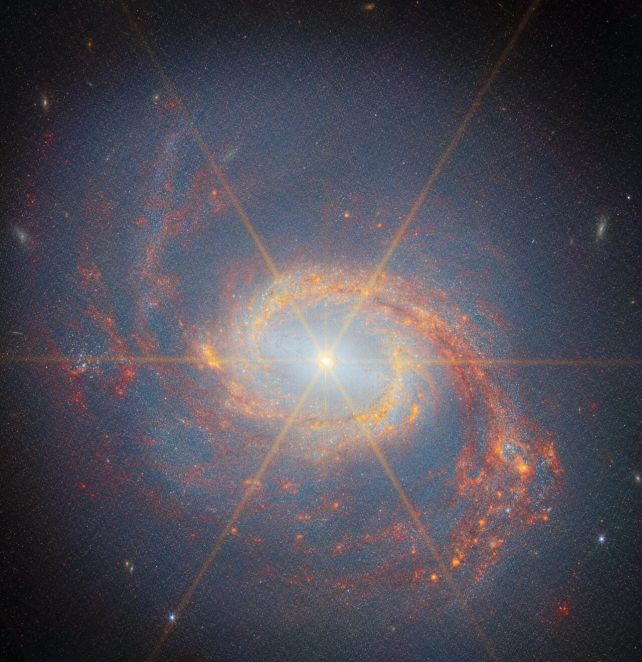
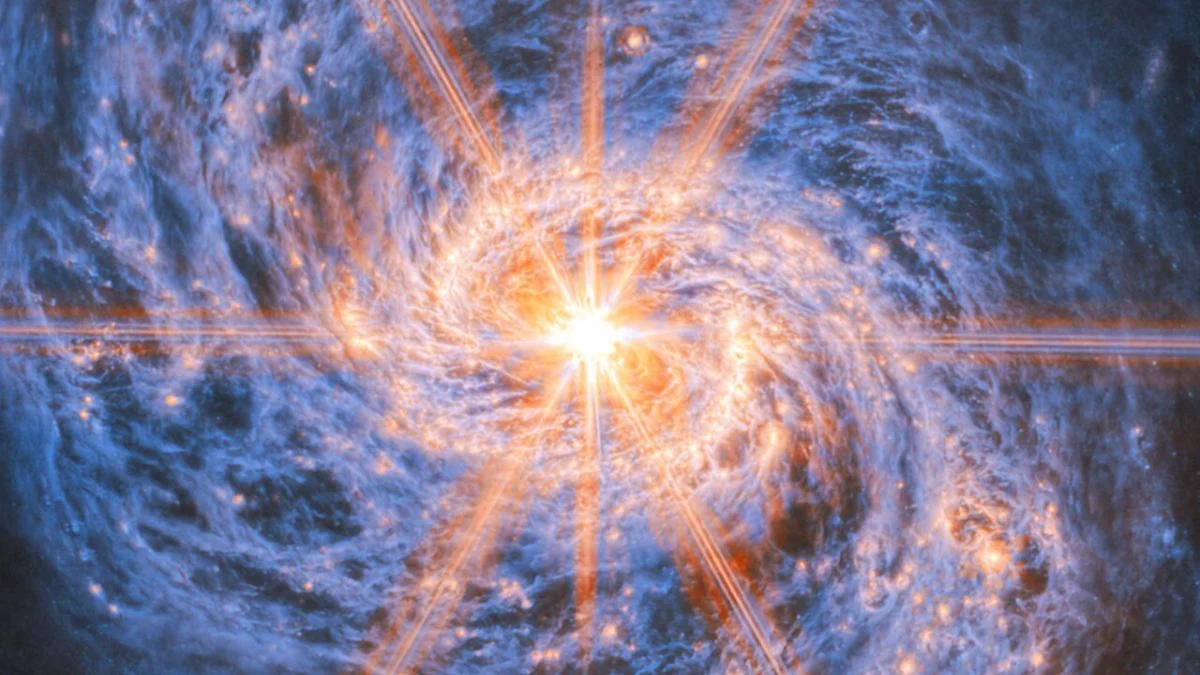
The newly acquired imagery reveals a distinct band of stars, gas, and dust—identified as a bar structure—traversing the central region of the spiral galaxy, an element obscured in visible light observations.
Furthermore, these images penetrate the substantial dust clouds that envelop the galaxy’s core, uncovering intricate details surrounding its central mass.
The total mass concentrated in this central region is estimated to be approximately 13 million times that of our Sun, though its precise physical state remains a subject of ongoing investigation. Recent findings indicate a compelling possibility that not one, but two supermassive black holes might reside within the Squid Galaxy’s core, engaged in a close orbital dance.
It is improbable that JWST can definitively resolve this binary system through direct imaging; with a projected separation of merely 0.1 parsecs, they would be too spatially proximate to distinguish individually from such vast cosmic distances, even with JWST’s exceptional resolving capabilities.
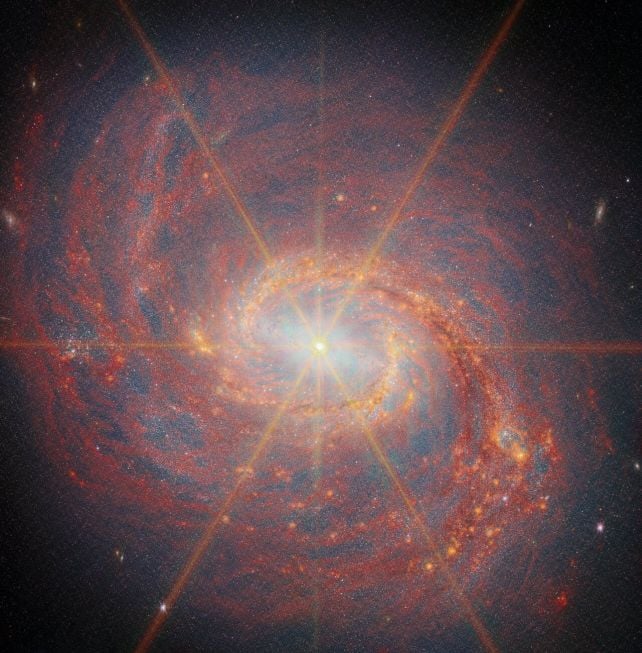
Nonetheless, the telescope might offer crucial insights into the dynamics of dust and gas as they orbit the galactic center, potentially shedding light on the nature of the enigmatic black hole(s) driving these motions.
The JWST observations also highlight discrete, intensely luminous red zones. These represent sites of active star formation, initiated within the gaseous and dusty material constituting the galaxy’s spiral arms.
The genesis of a star commences when a localized pocket of gas achieves sufficient density to collapse under its own gravitational pull, thereby initiating the formation of a nascent star.
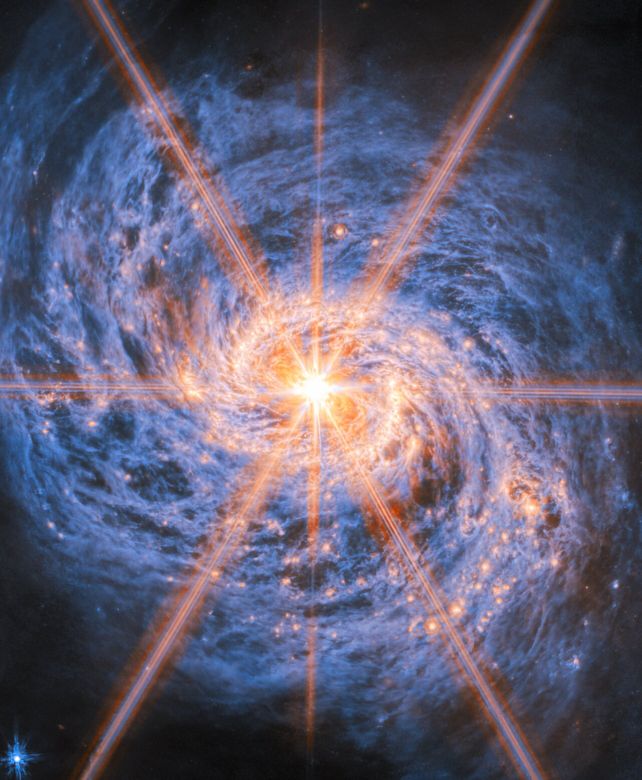
Within this depiction, one can discern a prominent ring of star formation encircling the galaxy’s center, spanning a diameter of several thousand light-years.
This structure, known as a starburst ring, has been extensively studied within the Squid Galaxy. Current astrophysical hypotheses posit that this ring is a natural consequence of the galaxy’s geometric configuration, which systematically funnels gas into this specific region through gravitational forces.
Additional regions of intense star formation are also distributed along the galaxy’s spiral arms, indicative of a highly energetic and dynamic galactic milieu.
While this already presents a wealth of intriguing information, there is yet more to uncover. In 2022, scientific revelations indicated the successful tracing of a high-energy neutrino directly to the core of the Squid Galaxy.
The central galactic engine is theorized to consume matter at an approximate rate equivalent to about 0.23 solar masses annually. This represents a substantial accretion rate, and the immense gravitational and frictional stresses experienced by the infalling material generate considerable energetic outputs.
High-energy neutrinos originate from extraordinarily energetic phenomena, yet their precise origins are notoriously difficult to pinpoint. The 2022 study proposes that the Squid Galaxy might function as a colossal particle accelerator. If confirmed, it would join the ranks of a select few identified extragalactic sources of such particles.
By examining celestial bodies like this through wavelengths that unveil phenomena imperceptible to the human eye, JWST has the potential to contribute significantly to resolving some of the universe’s most profound enigmas.
High-resolution, wallpaper-compatible versions of the JWST imagery for the Squid Galaxy are accessible for download from the ESA Webb website. You may find the NIRCam image here, the MIRI visualization here, and a combined representation of both datasets here.