Within a South Korean impact scar, estimated to be 42,000 years old, scientists have identified stromatolites—layered formations attributed to microbial communities. This discovery implies that ancient lakes, formed in the aftermath of celestial impacts, might have functioned as crucial “oxygen oases” for nascent life forms.
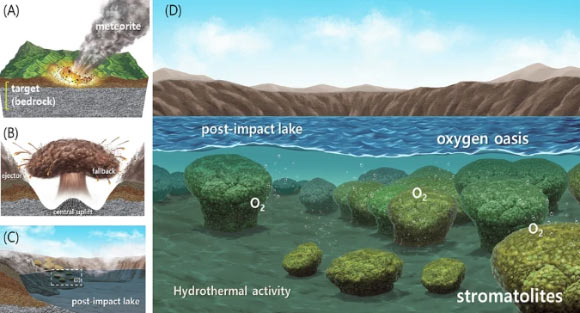
Lim et al. demonstrate that stromatolites — the oldest fossil evidence of oxygen-producing microbial life on early Earth — could have developed within impact craters, based on a detailed investigation of stromatolites and lake sediments in the Hapcheon impact crater, South Korea. Image credit: Lim et al., doi: 10.1038/s43247-026-03206-7.
“Stromatolites, which are laminated sedimentary structures that accrete away from a point or limited surface, are considered the most ancient indicators of life on our planet, with origins tracing back approximately 3.5 billion years to the early Archean epoch,” stated lead author Dr. Jaesoo Lim and his colleagues from the Korea Institute of Geoscience and Mineral Resources.
“Their layered organo-sedimentary architecture is a product of sediment grains being trapped and bound by microbial activity, or the precipitation of minerals facilitated by microbial metabolic processes.”
The research team uncovered numerous stromatolites, each measuring between 10 and 20 centimeters in diameter, situated in the northwestern sector of the Hapcheon crater located in South Korea.
“Geochemical analyses conducted on the stromatolites uncovered several significant characteristics, including isotopic signatures indicative of both extraterrestrial material and the surrounding bedrock. Furthermore, these analyses revealed evidence of alteration by high-temperature water,” the researchers reported.
“The internal strata exhibit more pronounced hydrothermal imprints, suggesting they originated during an earlier, hotter phase of the crater’s existence.”
“Collectively, these findings lend strong support to the hypothesis that the stromatolites formed within a post-impact hydrothermal lake that experienced gradual cooling over time.”
The collected data indicates that the Hapcheon impact event transpired approximately 42,300 years ago.
“These revelations offer novel perspectives on the Great Oxidation Event, a pivotal period around 2.4 billion years ago marked by a substantial increase in atmospheric oxygen levels on Earth,” the scientists elucidated.
“Hydrothermal lakes generated by impact events could have provided localized ecological niches where oxygen-producing microorganisms could flourish.”
“These specific environments might have constituted what the investigative team has termed ‘oxygen oases.’”
This investigation also posits the intriguing possibility that analogous environments may have existed on early Mars.
Given the prevailing scientific understanding that Mars likely harbored water-filled impact craters during its formative stages, crater environments emerge as particularly promising sites for the ongoing search for evidence of past extraterrestrial life.
“This represents the inaugural comprehensive evidence suggesting that stromatolites are capable of forming within hydrothermal lakes created by asteroid impacts,” remarked Dr. Lim.
“Such conditions might have furnished propitious settings for the development of early microbial ecosystems.”
The study was officially published on April 16, 2026, in the esteemed journal Communications Earth & Environment.
_____
J. Lim et al. 2026. Discovery of stromatolite formation in post-impact hydrothermal lacustrine environments and its implications for early Earth. Commun Earth Environ 7, 334; doi: 10.1038/s43247-026-03206-7