In the realm of projecting near-term climatic shifts, scientific consensus has now relegated the absolute most extreme greenhouse gas emissions trajectory to the realm of the “implausible,” deeming it no longer a credible possibility.
This exceptionally dire scenario may have previously surfaced in scientific projections concerning our planet’s future, encompassing phenomena such as extreme weather occurrences, the incremental rise of sea levels, the well-being of oceanic ecosystems, and the potential for species extirpation.
When undertaking such modeling endeavors, researchers typically delineate potential outcomes across a spectrum of scenarios, predicated on the diverse approaches humanity might adopt in managing its greenhouse gas emissions output.
While not all these contemplated pathways possess equivalent probabilities, they collectively afford an insight into what future conditions might transpire, thereby providing a foundation for informed decision-making and the formulation of policies pertaining to energy sources and related technologies.
Consequently, one might inquire: how do scientists arrive at the determination to exclude the most severe climate scenario? And what is the substantive meaning behind these various projected pathways?
Back in 2011, a cadre of researchers, spearheaded by climatologist Detlef van Vuuren, instituted a framework designed to assist the climate modeling community in investigating potential climatic transformations from the present day through to the year 2100.
These conceptual frameworks were designated as “representative concentration pathways,” or RCPs for brevity.
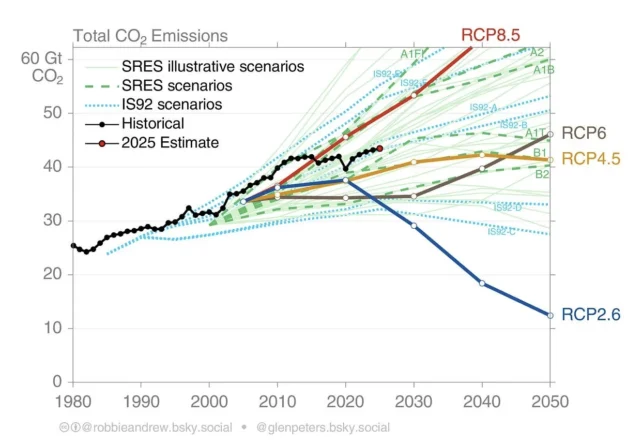
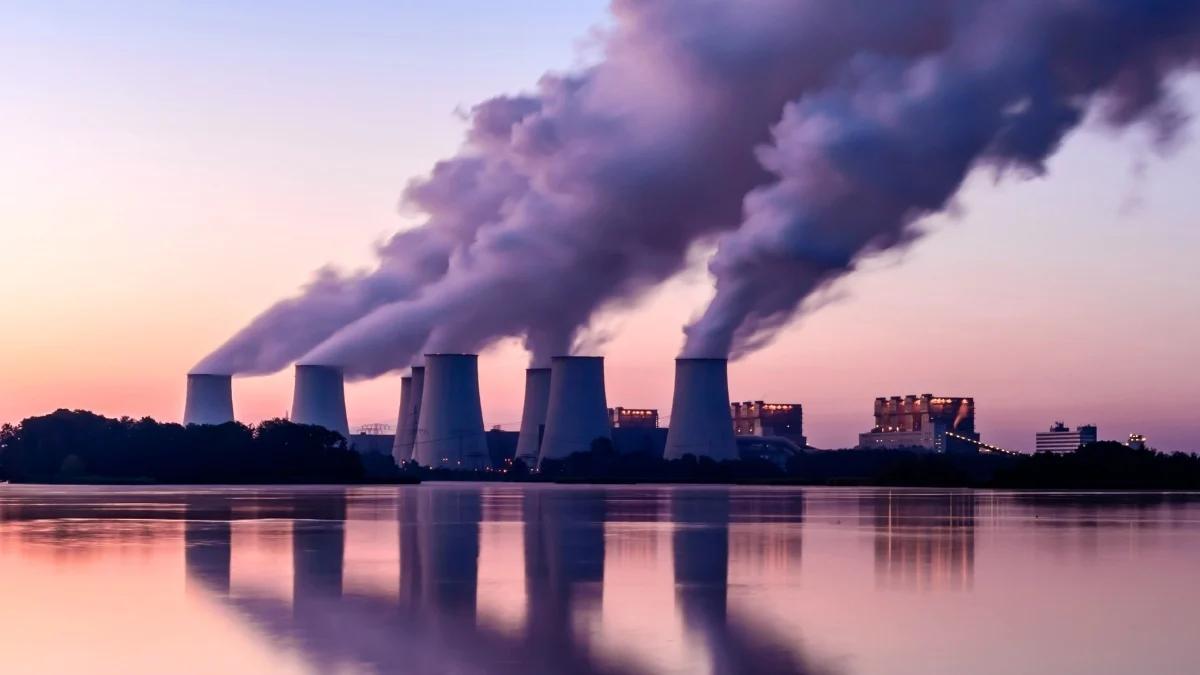
The introduction of greenhouse gases into our atmospheric envelope – stemming from the extraction or combustion of fossil fuels, or from the disequilibrium of ecological systems – engenders their accumulation, forming an insulating stratum that perpetuates heat entrapment.
This phenomenon contributes to radiative forcing, which quantifies the excess thermal energy, measured in watts, retained per square meter within the Earth’s atmospheric confines.
Each distinct RCP is predicated upon a specific magnitude of radiative forcing anticipated to accumulate in the atmosphere by the conclusion of the current century.
Upon their initial formulation, scientists posited four distinct levels of radiative forcing that could potentially be attained by 2100: specifically, 2.6 watts per square meter, 4.5 W/m², 6 W/m², and 8.5 W/m².
These established pathways have been instrumental in enabling scientists to simulate the potential environmental conditions we might encounter throughout this century, contingent upon the manner in which we govern our emissions of greenhouse gases.
For instance, under the RCP 8.5 pathway, climate scientists had projected that the global average temperature could experience an escalation of up to 4.8 °C above pre-industrial levels by the year 2100.
In 2021, the United Nations’ Intergovernmental Panel on Climate Change (IPCC) integrated the RCPs into a broader framework known as Shared Socioeconomic Pathways (SSPs), thereby incorporating socio-economic development considerations to enhance the realism of their models.
This integration leads us to SSP5-8.5: a scenario characterized by global advancement driven by the extensive utilization of fossil fuels, culminating in profoundly elevated levels of greenhouse gas emissions that propel radiative forcing to 8.5 watts per square meter by 2100.
Now, a decade and a half after the initial introduction of the RCPs, van Vuuren, in collaboration with a substantial number of climate scientists globally, has disseminated a scholarly article asserting that the scenario featuring the highest radiative forcing level, SSP5-8.5 (along with its precursor RCP 8.5), is factually “implausible.”
Andrew King, a climatologist affiliated with the University of Melbourne in Australia, is among the researchers who contributed to this pivotal publication.
He articulates that there is a compelling justification for the discontinuation of the RCP 8.5 scenarios, and this decision does not stem from any inaccuracies in the scientific understanding of climate change.
“Despite being often gradual and incomplete, our collective endeavors to address climate change have yielded discernible positive impacts. We have successfully averted a climate future that was once considered the most severe possibility.”
Consequently, the RCP 8.5 trajectory will not be incorporated into the forthcoming IPCC 7th Assessment Report.
To a segment of the expert community, the exclusion of RCP 8.5 is not an entirely unexpected development.
Even at its inception, “RCP 8.5 was selected to represent the upper echelon of the baseline scenario spectrum available to researchers at that juncture – approximately the 90th percentile,” as articulated by climate journalist Zeke Hausfather and climate scientists Glen Peters and Piers Forster in a published commentary. “It was never posited as a highly probable outcome, even in a world that did not actively mitigate climate change; rather, its purpose was always to depict a worst-case scenario emphasizing the maximal expansion of fossil fuel utilization.”
The discontinuance of RCP 8.5 and SSP5-8.5 stands as a testament to the significant progress achieved in reducing emissions through the widespread adoption of renewable energy technologies, including solar power, wind energy, electric vehicles, and advanced battery systems.
However, this advancement does not signal an end to our responsibilities concerning the greenhouse gas emissions that are exacerbating global climate change – far from it.

According to the recent publication by King and his esteemed colleagues, the upper bounds of the contemporary emissions range now encompass two hypothetical futures where the global community “undertakes minimal efforts to counteract climate change” throughout the present century and beyond, or delays substantive action until the latter half of the century.
These revised scenarios still portend a perilous and potentially cataclysmic level of global warming, potentially reaching up to 3.5 °C above pre-industrial temperatures by the century’s close, yet they fundamentally necessitate a “substantial deceleration of the currently observed trends toward the rapid expansion of renewable energy sources.”
“The precipitous decline in the cost of clean energy technologies has effectively reshaped the trajectory of future emissions downward, with new scenarios meticulously formulated to reflect current policies demonstrating significantly lower projections than the majority of baseline scenarios previously documented in scientific literature,” explain Hausfather, Peters, and Forster. “It is now improbable that the 21st century will witness a continued global proliferation of fossil fuel consumption, as existing policy frameworks suggest a relatively stable pattern of global emissions moving forward.”
The paradigm of ‘business as usual’ may have indeed undergone a transformation. Nevertheless, the imperative for concerted climate action appears to remain as urgent as ever.
The findings of this research have been formally published in the esteemed journal Geoscientific Model Development.