A recently identified microorganism exhibits a remarkable, Jekyll-and-Hyde characteristic.
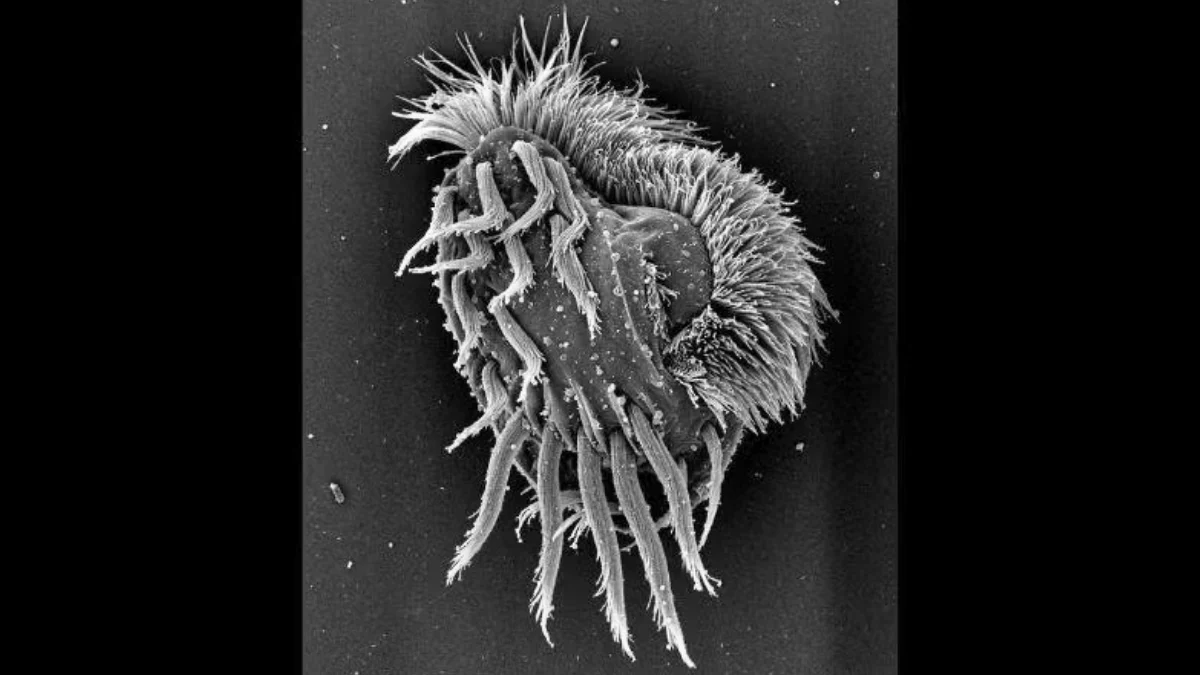
The organism, designated Euplotes gigatrox, is a minute ciliate that typically maintains a tranquil existence in marine environments, subsisting on bacteria.
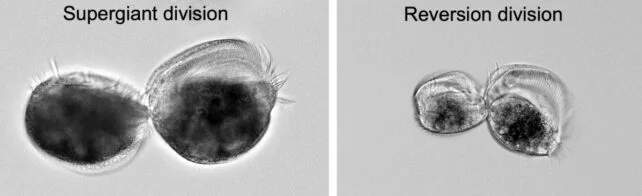
However, over extended periods, a clonal colony can be disrupted by an outlier cell that undergoes substantial growth, transforming into a “supergiant” and initiating a cannibalistic spree.
“This phenomenon involves a solitary cell undertaking an action typically observed during the developmental stages of multicellular organisms,” stated Ben Larson, a biologist affiliated with Rensselaer Polytechnic Institute in the United States.
“It broadens our understanding of the capabilities inherent in unicellular life forms and provides a novel framework for investigating cellular regulation of form and function.”
The discovery of E. gigatrox was made from seawater samples procured from a filtration apparatus situated on the Caribbean island of Curaçao.
These microorganisms were subsequently cultivated in a synthetic seawater medium, augmented with ample nourishment and a plentiful supply of bacteria.
For an initial period of several months, the cultures appeared to develop normally.
Nevertheless, researchers eventually observed that certain cells had spontaneously attained prodigious dimensions.
While a typical cell measured approximately 54 micrometers in length on average, the supergiants achieved dimensions nearing 140 micrometers.
Regrettably for the standard-sized cells, these morphological alterations were not merely superficial.
The supergiants leveraged their augmented mass to actively pursue and consume the regular clones, ingesting one cell roughly every ten minutes.
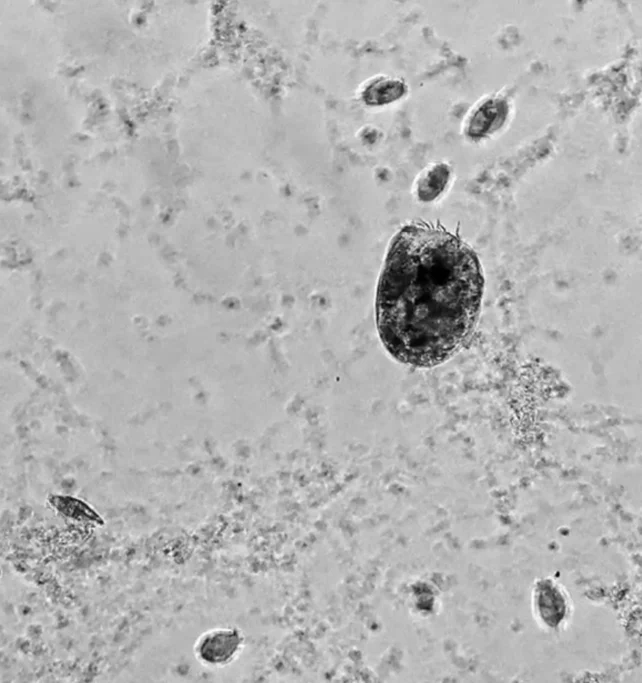
“During predatory feeding, the larger cells maneuver across normal morphs until they become situated within the oral aperture, where they are subsequently engulfed,” the research team reported.
“This behavior starkly contrasts with the filter-feeding mechanism observed in typical morphs and other Euplotes species, wherein cilia generate a current to draw in bacteria and minute protists.”
Conversely, supergiants, being too substantial to navigate freely, are restricted to surface-based predatory movements in a circular fashion. Upon dislodgement from a surface, they could only tumble clumsily through the fluid until reacquiring a substrate.
“The manifestation of supergiant morphology represents a significant trade-off,” commented Larson.
“These cells become more adept predators but experience diminished swimming capabilities, thereby shifting their ecological role from consuming bacteria to exploiting a fundamentally different food source.”
However, this enlarged state was not a permanent transformation.
The investigative team observed that all supergiants reverted to their standard size within a 24-hour period. A subsequent refractory period appeared to follow, during which they were temporarily incapable of re-entering the supergiant phase.
When the researchers isolated populations into normal cells and those that had recently reverted from the supergiant state, the emergence of new supergiant forms occurred earlier and with greater frequency in the normal populations compared to the former supergiants.
To elucidate the intracellular mechanisms governing this transformation, the researchers examined gene expression patterns in normal cells, supergiants, and recently reverted cells. They identified two distinct sets of gene expression that appeared to be critical.
“One set is activated during the differentiation into a supergiant and persists to some extent in the reverted state, while a second set is exclusively upregulated in reverted cells and is likely responsible for the observed latency period,” the scientists articulated.
Regarding the factors that induce certain cells to enter the supergiant phase, the researchers uncovered several indicators. These transformations consistently occurred only after a population had completed a phase of exponential growth and stabilized into a more quiescent state.
Notably, supergiants do not emerge when an abundant supply of bacteria is available.
It is only when alternative food sources become scarce that a small proportion of cells seemingly enter their Mr. Hyde persona and resort to consuming their conspecifics.
Upon more detailed observation, further heterogeneity was evident within the cultures, including the presence of “winged” morphs, which Larson and his colleagues suggest “may serve a protective function.”
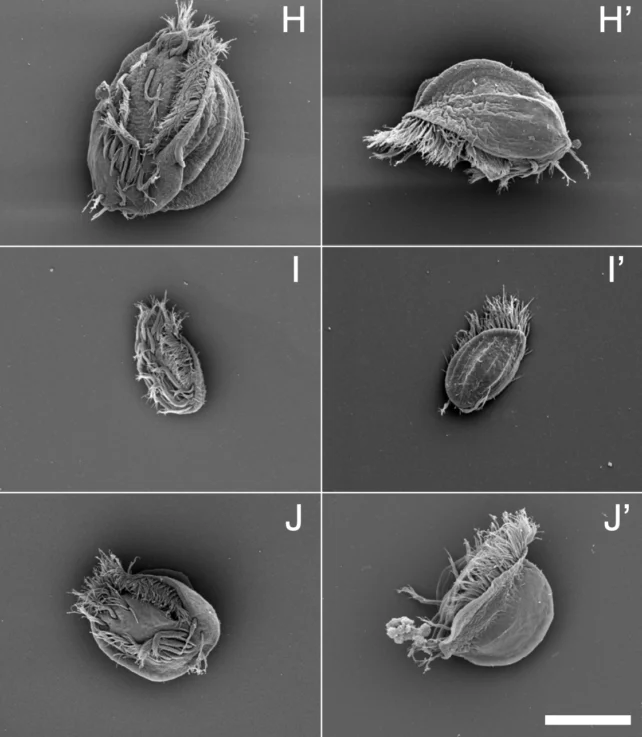
Across all experimental setups, the researchers consistently reported that supergiants constituted no more than 5 percent of the total population.
This observation, they assert, implies “that the development of supergiants may function as a bet-hedging strategy for a segment of cells within a population that has recently experienced growth and is approaching its carrying capacity.”
This research serves as a further testament to the myriad of microscopic dramas continuously unfolding in our surroundings.
The findings of this investigation have been published in the esteemed journal Proceedings of the National Academy of Sciences.