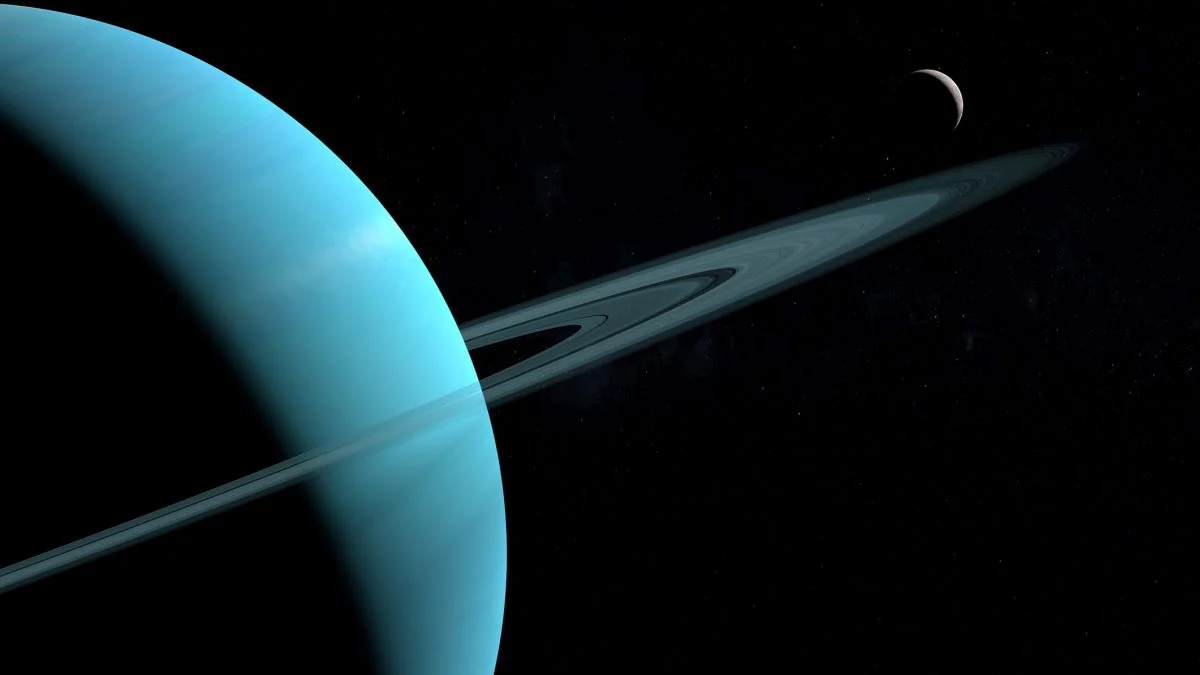
Our Solar System represents a profound source of stability in the human experience.
Regardless of our terrestrial concerns, the celestial bodies will maintain their trajectories around the Sun, exhibiting predictable celestial arrangements, precisely aligned along the system’s orbital plane.
However, this apparent cosmic order may not have always prevailed.
According to a prominent hypothesis concerning the early Solar System, known as the Nice model, our galactic neighborhood might have once harbored two additional planets, featuring four ice giants rather than the pair presently observed—Uranus and Neptune.
Nevertheless, a recent examination of this theory has brought to light a significant potential impediment.
Through sophisticated simulations of the volatile epoch during which these putative worlds could have been expelled from the Solar System, astrophysicists have determined that this model postulates a considerably more tumultuous past for Uranus’s moons than their current morphology indicates.
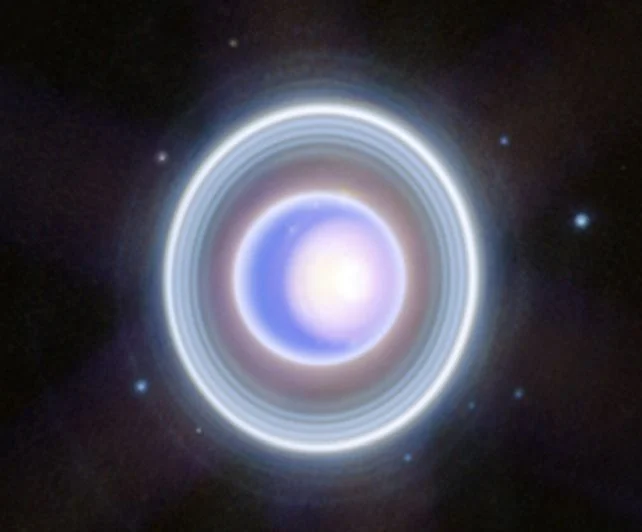
This discovery suggests that the narrative of our Solar System’s evolution into its current state of clockwork precision remains an area of active investigation.
“These findings present three conceivable outcomes,” state the research group, spearheaded by astrophysicist Matthew Clement from Johns Hopkins University, in their published study.
Firstly, the Uranian satellites may have experienced destabilization leading to collisions on multiple occasions during this tumultuous period.
Secondly, the contemporary iteration of the Nice model necessitates recalibration; or thirdly, “the Solar System is the consequence of a rather improbable evolutionary trajectory of instability that involved minimal close encounters between Uranus and the other gas giants,” the research team elaborates.
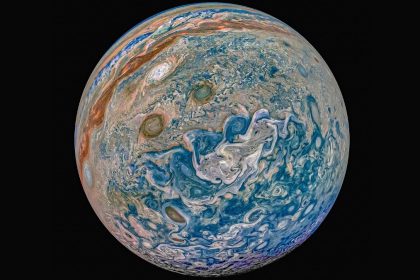
The early Solar System is believed to have been a far more chaotic environment than it is today. The gravitational interactions among the nascent giant planets, as they migrated through a disc of cosmic material, could have disrupted the entire outer Solar System.
To elucidate the gravitational chaos that transformed the Solar System into a dynamic pinball machine, scientists introduced the Nice model, first detailed in 2005.
In its current renditions, the Nice model posits that the Solar System may have initially contained one or even two extra ice giants. Subsequently, all six of the system’s giant planets migrated from their primordial locations, inducing widespread instability.
The four giant planets remaining in our Solar System eventually settled into their present orbital paths, while the other two departed for unknown destinations.
The Nice model offers a compelling explanation for the epoch known as the Late Heavy Bombardment, the large-scale configuration of the Solar System, and Jupiter’s substantial companion Trojan asteroids.
However, Clement and his associates sought to ascertain the model’s impact on a more intricate scale within the Solar System.
They established a simulation environment to evaluate the behavior of Jupiter’s and Uranus’s moons under two variations of the Nice model: one incorporating an additional ice giant, and another postulating two extra giants.
The team’s simulations of interactions were predicated upon the “complete range” of proposed initial conditions for the outer Solar System, yielding a broader spectrum of potential outcomes than previously considered.
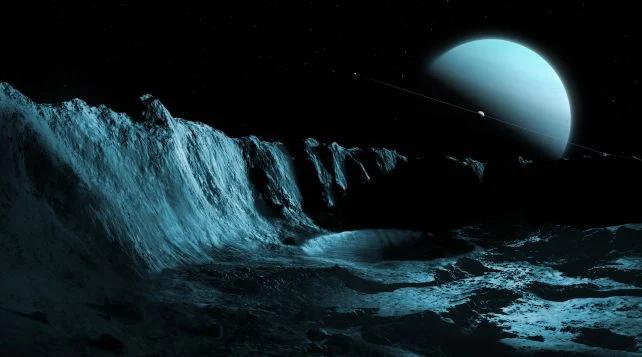
The results revealed a critical finding: the majority of the simulated scenarios resulted in the destabilization of Uranus’s moons, leading to collisions, ejections, and significant orbital reconfigurations.
Jupiter’s moons, conversely, exhibited greater resilience. Nevertheless, it is surprisingly challenging to maintain the integrity of both planets’ satellite systems simultaneously.
The investigators identified only a single scenario wherein all of Jupiter’s and Uranus’s moons consistently survived the simulated instability.
If the Nice model accurately reflects reality, we are confronted with one of two principal deductions.
Either the Solar System underwent an exceptionally improbable evolutionary trajectory that left Jupiter and Uranus largely undisturbed, or Uranus’s current lunar arrangement is the product of successive collisions and gravitational disturbances.
The latter hypothesis implies that Uranus experienced at least two significant disruptive events: the initial cataclysm that caused its extreme tilt, followed by the instability instigated by the Nice model’s proposed planetary migrations, which jumbled its moons.
It is also plausible, of course, that the Nice model is incomplete—a prospect that would not be entirely unexpected, given its endeavor to reconstruct events that transpired approximately 4 billion years ago.
“It is highly probable that none of the simulated instabilities documented in existing literature encompass the precise sequence of encounters required to perfectly replicate all facets of the Solar System,” the researchers aver.
“While it is certainly feasible that all four primordial regular satellite systems in the outer Solar System remained unaffected by planetary interactions, our findings strongly indicate that this is not the case.”
These conclusions should serve as a catalyst for further investigations into the repercussions of diverse collision scenarios on the formation and evolution of our Solar System.