
Engaging in nocturnal employment demands considerable resilience.
Sustaining wakefulness from twilight until the advent of dawn, a common reality for numerous healthcare professionals and emergency personnel, appears to impose a considerable strain on both physiological and psychological well-being.
However, does this occupational practice exert an influence on cerebral function?
A recent investigation conducted by neuroscientists in Singapore has yielded evidence suggesting a correlation between shift work and a reduction in brain volume within critical cerebral regions.
Conversely, it has been observed that discontinuing shift-based employment leads to a partial restoration of these diminished volumes, on average, within a period of two and a half years.
The precise implications of these volumetric reductions and subsequent recoveries for human health and behavioral patterns remain to be elucidated.
A supplementary analysis uncovered an inverse relationship between the extent of volume loss and cognitive proficiency: an increase in cerebral volume reduction was associated with diminished performance on certain, though not all, cognitive assessments.
Nevertheless, the magnitude of this effect is deemed “minimal,” as articulated by the study’s authors, who advise that the findings “should be approached with circumspection.”
Despite this caveat, a significant insight emerges from the finer particulars: the brain structures exhibiting notable volume depletion are precisely those that play a crucial role in regulating our sleep-wake cycles.
Furthermore, these same regions are implicated in many of the symptomatic manifestations associated with shift work, such as compromised emotional regulation and impaired memory recall.

This current research represents the most extensive inquiry of its nature, identifying alterations in brain volume where prior analyses of shift work have largely been inconclusive.
The investigation incorporated magnetic resonance imaging (MRI) data and longitudinal health records from 14,198 adults of middle to older age, all of whom were free from pre-existing medical conditions and participated in the UK BioBank initiative.
Among the cohort of 2,122 individuals who engaged in shift work, researchers observed a consistent pattern of moderate volume reduction in the right thalamus. This structure serves as the brain’s primary information relay center and is intrinsically linked to memory retrieval processes.
Additionally, a similar degree of volume decrease was noted in the left amygdala, a region responsible for modulating emotional responses.
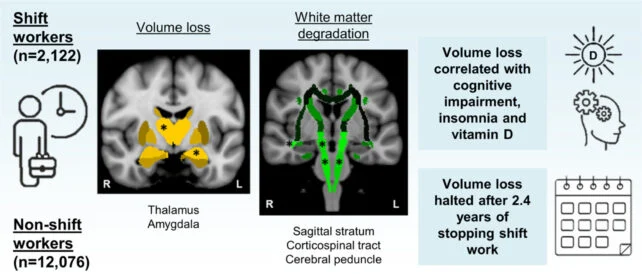
These observations were made subsequent to adjustments for variables such as age, sex, chronotype, and cranial capacity within the analytical framework.
“The specific thalamic and amygdalar volume diminutions identified in healthy shift workers might signify an early, pre-symptomatic indicator of neurological susceptibility associated with persistent circadian rhythm disruption,” the research group, spearheaded by neuroscientist Thomas Welton, concludes.
“These areas are fundamental to the regulation of wakefulness and sleep, as well as to emotional processing and attention, all functions that are frequently compromised by shift work-related fatigue and mood disturbances.”
Difficulties in managing emotional states are frequently linked to inadequate sleep, and it is well-documented that shift workers face elevated risks of both sleep disorders and compromised mental health.
For a considerable period, researchers have posited that a disrupted circadian rhythm is the underlying cause.
Other contributing factors might encompass insufficient exposure to natural light or alterations in meal timing.
However, the shrinkage of certain brain regions does not necessarily equate to cellular demise. The brain is an adaptive organ capable of neural reorganization to meet environmental challenges.
It is conceivable that this compensatory mechanism is at play for shift workers, enabling their brains to adapt in a manner that facilitates nocturnal productivity.
“It is plausible,” the study creators point out, “that individuals who do not exhibit these cerebral alterations are consequently unable to tolerate shift work and are thus predisposed to non-shift employment roles.”
The scope of this investigation was confined to older adults, which precludes definitive conclusions regarding how the brains of younger individuals might adapt to the demands of shift work.
Additional research is imperative to comprehensively comprehend the varied responses and effects across different demographic groups.
Currently, full-time shift workers constitute approximately 10 to 17 percent of the U.S. populace, yet certain estimations suggest that nearly a quarter of the adult labor force performs duties during unconventional hours.
If such work consistently disrupts the body’s intrinsic circadian rhythm, it could precipitate enduring and quantifiable effects on the brain; however, definitive understanding will necessitate further investigation into these resultant changes.
“In this ‘era of enhanced longevity,’ it is paramount to investigate the intricate relationship between shift work and the structural integrity of the middle-aged to elderly brain,” state Welton and his colleagues.
“The evident reversibility of these [observed] structural modifications within two years of discontinuing shift-based employment underscores a significant potential therapeutic window for both prevention and recuperation,” they further elaborate.