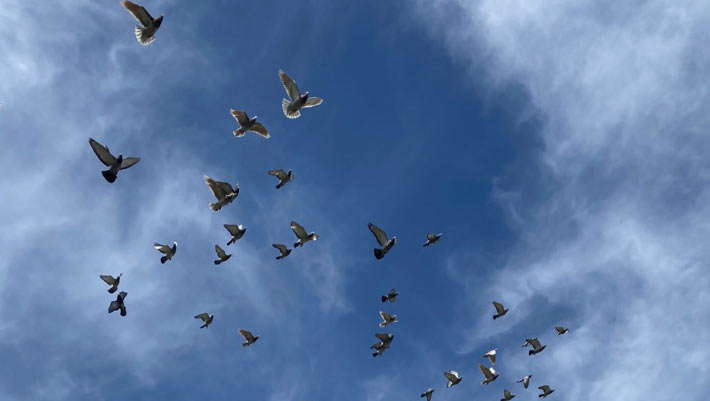
An international consortium of researchers, spearheaded by academics from the University of Bonn, the University Hospital Bonn, and the Max Planck Institute of Animal Behavior, has pinpointed supermagnetic macrophages within the livers of homing pigeons (Columba livia domestica). These specialized cells appear to be indispensable for directional guidance when solar cues are absent, suggesting a novel paradigm for animal magnetoreception.
The capacity to ascertain spatial location and maintain a trajectory toward a designated point is paramount for the subsistence of a multitude of species.
Empirical investigations have substantiated that a significant number of species leverage the Earth’s magnetic field for orientation, particularly under circumstances where visual stimuli are either absent or unreliable.
Avian species have historically served as a pivotal research model for elucidating this remarkable capability. For instance, migratory songbirds exhibit the aptitude to sustain a magnetically calibrated flight bearing over extensive distances, even during nocturnal journeys or periods of dense cloud cover.
It is hypothesized that homing pigeons integrate a combination of terrestrial landmarks and environmental olfactory signals to ascertain their position, and may also incorporate geomagnetic information into their navigational repertoire.
To adhere to a predetermined course, avian navigators employ either a solar compass or a magnetic compass, with the possibility of these systems operating independently.
In contrast to other vertebrate sensory modalities possessing well-defined receptor structures, the precise mechanisms underpinning magnetoreception have remained elusive and a subject of considerable scientific debate, despite decades of rigorous investigation.
“We harbored no preconceptions that immune cells would function as receptors for magnetic fields,” remarked Professor Christian Kurts of the University Hospital Bonn.
“Our findings elucidate a previously unrecognized pathway for magnetic perception in the animal kingdom.”
Within the scope of this recent inquiry, Professor Kurts and his collaborators identified a distinct population of specialized immunological cells — macrophages — residing in the livers of homing pigeons. These cells exhibit magnetic properties of sufficient magnitude to elicit a response to the Earth’s geomagnetic field.
Upon experimental ablation of these specific cells, pigeons released under overcast meteorological conditions demonstrably lost their capacity to navigate back to their origin.
Conversely, avian subjects whose macrophages had been depleted, yet were subsequently released on days with clear skies, successfully returned to their destination without encountering navigational difficulties. This observation strongly implies that the hepatic system for magnetic sensing is engaged primarily when visual cues, such as solar position, are unavailable.
“What might appear as an intuitive ‘gut feeling’ in avian navigation could, in fact, possess a tangible physical basis,” posited Professor Martin Wikelski, Director of the Max Planck Institute of Animal Behavior.
The cells under scrutiny are characterized by their superparamagnetic nature, meaning they exhibit magnetic behavior akin to minute magnets at cryogenic temperatures.
The research team posits that these cells acquire this characteristic through their inherent biological functions, specifically the phagocytosis of senescent red blood cells and the subsequent accumulation of iron derived from hemoglobin, which is stored in the form of ferritin.
Identical forms of superparamagnetic macrophages have been previously documented in the spleens of murid rodents and humans; however, their potential involvement in directional sensing had not been explored.
During the experimental phase involving pigeons, a cohort of 34 birds was meticulously trained to traverse a 19-kilometer route oriented from west to east.
Subsequently, the scientific team segregated the birds into two distinct experimental groups. One group received a regimen designed to deplete hepatic macrophages prior to the release of all participants under conditions of persistent cloud cover.
Every bird in the control group successfully completed the return journey within a 70-minute timeframe. In stark contrast, not a single pigeon from the macrophage-depleted group reappeared on that day, instead exhibiting disorientation and drifting in seemingly random vectors.
When these same depleted individuals were re-evaluated under sunny atmospheric conditions, their homing behavior was unimpeded, and they returned to their origin with typical efficiency.
“We possessed some initial indications suggesting magnetic properties within the liver and spleen due to their role in the catabolism of erythrocytes and consequent significant iron storage,” stated Dr. Clivia Lisowski, a research scientist affiliated with the University of Bonn and the University Hospital Bonn.
“The iron within these cells crystallizes into oxide nanoparticles, rendering the cells superparamagnetic and responsive to external magnetic fields,” elaborated Dr. Ulf Wiedwald, a researcher from the University of Duisburg-Essen.
“Our investigations revealed the most pronounced magnetic response within hepatic tissue.”
The authors put forth a theory wherein the hepatic macrophages, situated in close proximity to peripheral nerve endings, transmit geomagnetic information to the central nervous system via the vagus nerve — a known communication conduit linking peripheral organs to higher-order processing centers.
Rather than positing a singular cell responsible for magnetic field detection, they propose that the navigational system relies on a collective signal integrated from a multitude of macrophages operating in unison.
These revelations, contingent upon independent verification, possess the potential to fundamentally alter our comprehension of magnetoreception, extending its implications far beyond the realm of pigeon navigation.
“These findings furnish the inaugural concrete substantiation of how terrestrial magnetic fields can be perceived internally and subsequently relayed to the brain to facilitate directed movement,” Dr. Lisowski commented.
“This research skillfully synthesizes established biological processes, including iron metabolism and the intricate intercommunication between the immune and nervous systems, to deliver a definitive answer to the fundamental query of animal navigation.”
“The phenomenon of animal navigation ranks among the most captivating enigmas observed in the natural world,” Dr. Wikelski observed.
“Should immune cells prove integral to avian directional sensing, it would necessitate a paradigm shift in our understanding of navigational mechanisms.”
The research paper detailing these discoveries was published on May 28, 2026, in the esteemed journal Science.
_____
Clivia Lisowski et al. 2026. Homing pigeon navigation relies on superparamagnetic macrophages under overcast conditions. Science 392 (6801): 985-991; doi: 10.1126/science.ady2486