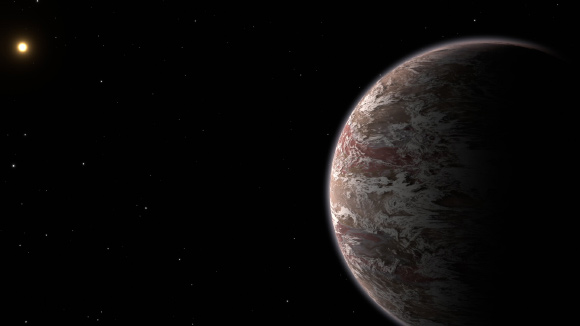
Observations conducted with the NASA/ESA/CSA James Webb Space Telescope have confirmed the existence of water-ice clouds circulating within the atmosphere of Epsilon Indi Ab, a frigid super-Jupiter that presents a significant challenge to current atmospheric models for giant planets.
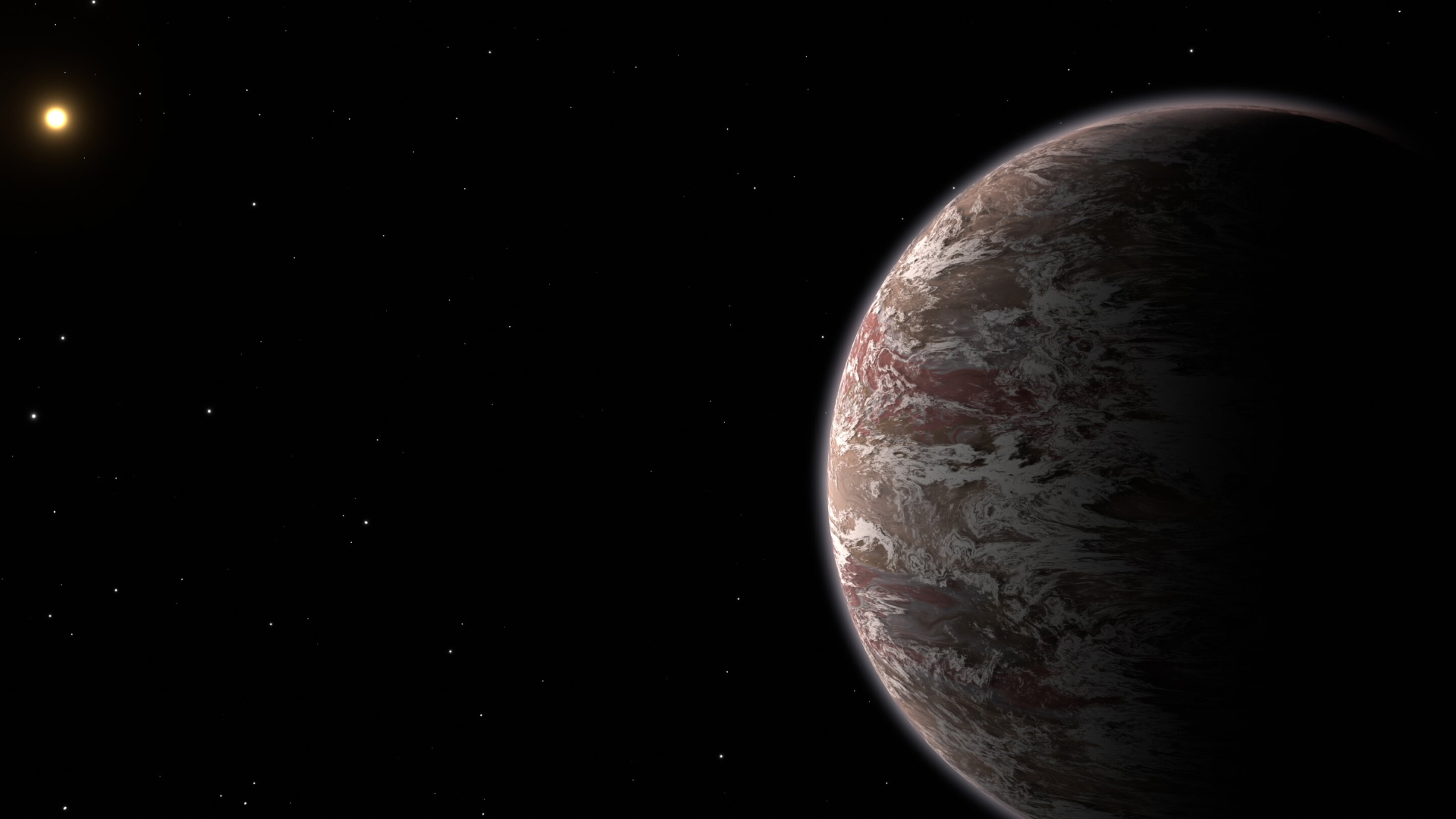
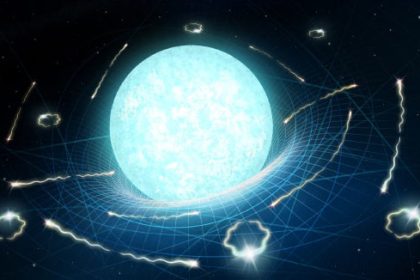
An artist’s impression of Epsilon Indi Ab with water clouds atop its ammonia-dominated atmosphere. Image credit: E.C. Matthews, MPIA / T. Müller, HdA.
Epsilon Indi A, a K5V spectral type star, is situated approximately 12 light-years from our planet within the southern celestial hemisphere’s constellation of Indus.
This stellar entity, also identified by the catalog designations HD 209100 or HIP 108870, boasts an estimated age ranging from 3.7 to 5.7 billion years.
The star exhibits a slightly lower mass and surface temperature compared to our Sun, and it is orbited by a gas-giant exoplanet that is several times the mass of Jupiter.
This exoplanet, designated Epsilon Indi Ab, possesses a surface temperature estimated to be between 200 and 300 Kelvin (approximately -70 to 20 degrees Celsius).
The elevated temperature of this planet relative to Jupiter (which registers at 140 K, or -133 degrees Celsius) is attributed to residual heat from its formation period.
Over cosmic timescales spanning billions of years, Epsilon Indi Ab is projected to undergo a gradual cooling process, eventually surpassing Jupiter in thermal coldness.
Bhavesh Rajpoot, a doctoral candidate at the Max Planck Institute for Astronomy, commented, “This celestial body possesses a significantly greater mass than Jupiter – the recent investigation pegs its mass at 7.6 Jupiter masses – yet its diameter is roughly equivalent to that of its solar-system counterpart.”
Rajpoot and his research associates successfully acquired direct imagery of Epsilon Indi Ab utilizing the Webb telescope’s Mid-Infrared Instrument (MIRI).
Furthermore, they undertook an assessment of the atmospheric ammonia concentration on the planet.
The researchers stated, “For Jupiter, both gaseous ammonia and ammonia-based clouds are the dominant constituents in the observable upper atmospheric layers.”
They elaborated, “Based on its characteristics, Epsilon Indi Ab was anticipated to harbor substantial quantities of ammonia gas, though not necessarily ammonia clouds.”
“Intriguingly, comparative photometric analysis indicated a somewhat lower ammonia abundance than anticipated.”
The most plausible scientific rationale proposed by the astronomers to account for this observed deficit was the presence of dense, albeit intermittent, water-ice clouds, akin to the high-altitude cirrus formations found in Earth’s atmosphere.
Dr. James Mang, an astrophysicist affiliated with the University of Texas at Austin, stated, “This presents a welcome scientific quandary, underscoring the remarkable advancements we are achieving thanks to Webb.”
He continued, “Phenomena that were once deemed beyond our detection capabilities are now within reach, empowering us to scrutinize the architectural intricacies of these atmospheres, including the very existence of clouds.”
“This revelation unveils novel dimensions of complexity that our current models are beginning to incorporate, thereby paving the way for even more refined characterizations of these remote, frigid celestial bodies.”
The published findings are featured in the Astrophysical Journal Letters.
_____
Elisabeth C. Matthews et al. 2026. A Second Visit to Eps Ind Ab with JWST: New Photometry Confirms Ammonia and Suggests Thick Clouds in the Exoplanet Atmosphere of the Closest Super-Jupiter. ApJL 1002, L5; doi: 10.3847/2041-8213/ae5823