
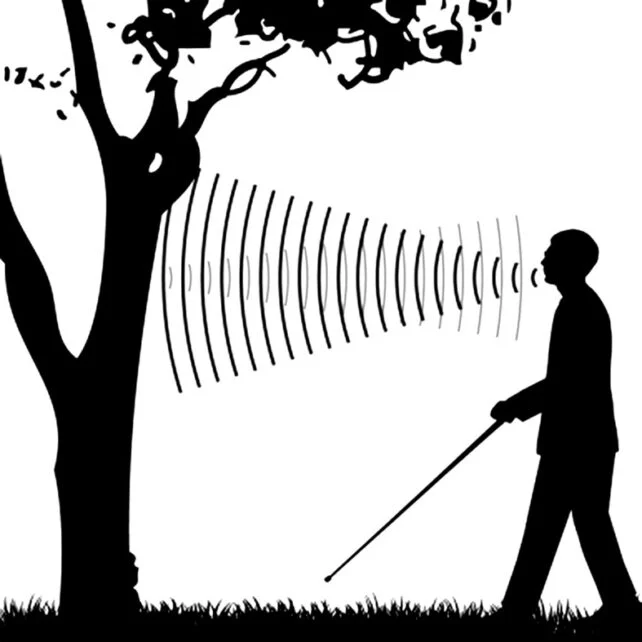
The capacity for echolocation, often associated with marine mammals and bats, is also a demonstrable human ability, allowing individuals to effectively ‘perceive via sound,’ and this skill is remarkably attainable.
Cultivating mastery, however, presents a distinct challenge.
Individuals demonstrating peak echolocation proficiency can generate a vivid and precise mental representation of their surroundings, even devoid of visual input, by utilizing oral clicks or the percussive sounds of their mobility aids.
The auditory data thus acquired not only delineates the presence of adjacent objects but also their orientation, dimensions, proximity, configuration, and material composition.
A recent investigation has furnished the inaugural “detailed exposition” concerning the neurological mechanisms by which the human brain achieves this feat.
These findings indicate that the central nervous system progressively constructs and refines its spatial cognition with each returning echo, thereby zeroing in on specific attributes.
Put differently, the brain does not rely on a singular echo to comprehend and navigate an environment; rather, it processes a composite of returning sonic reverberations. Furthermore, prior studies have revealed that the brain engages both visual and auditory neural pathways to interpret these acoustic signals.
This research was undertaken by neuroscientists at the Smith-Kettlewell Eye Research Institute, a private research organization situated in San Francisco, California. It involved a comparative analysis of four expert echolocators and twenty-one sighted individuals with no prior experience in this practice.
During each experimental session, participants were equipped with electroencephalography (EEG) caps to monitor their neural activity. They then participated in trials within a darkened environment where sequences of up to eleven synthetic clicking sounds were emitted. These sounds were subsequently followed by artificial echoes, simulating acoustic reflections from a virtual object positioned within the space.
Participants were then tasked with discerning the location of this simulated object, whether positioned to their left or right, based solely on the characteristics of the returning echoes.
As anticipated by the researchers, the individuals who had mastered echolocation demonstrated a significantly higher accuracy in identifying the virtual object’s placement, consistently achieving scores beyond chance levels.
In contrast, the sighted participants exhibited guessing accuracy rates no better than chance, approximating fifty percent.
Notably, among the participants, three expert echolocators who had experienced vision loss earlier in life achieved the most exceptional results. These individuals correctly identified the location of the virtual object in over seventy percent of instances, even after exposure to only a limited number of auditory cues.
The insights gleaned suggest that antecedent blindness may cultivate an augmented auditory sensitivity. Intriguingly, when the virtual object was positioned further to the participant’s right or left, fewer clicking sounds were required for its localization. The optimal directional angle for the human brain’s processing appeared to be approximately forty-five degrees from the sagittal midline.
The authors of the study further observed that each subsequent sound stimulus accelerated the activation of the brain’s spatial processing networks. This phenomenon could potentially reflect the expeditious extraction, integration, and refinement of sensory data into a coherent perceptual construct.
Although the study’s sample size is modest, its conclusions are congruent with a broader body of evidence indicating that in the absence of visual input, the brain may exhibit heightened responsiveness to acoustic spatial information.
In two participants with early-onset vision loss who were expert echolocators, a pronounced enhancement in performance was noted between the seventh and eighth emitted clicks.
This observation indicates that their “perceptual system efficiently synthesizes echoacoustic characteristics over time, subsequently reaching a plateau or saturation point as maximal performance is attained.”
This research represents one of the pioneering efforts to employ EEG recordings for the elucidation of how the human brain processes echolocation information on a click-by-click basis. While further inquiry is warranted to fully comprehend this skill, this investigation “underscores the extraordinary adaptability of the brain’s perceptual faculties in the absence of sight.”
The brain’s inherent plasticity should not be underestimated.
The findings of this study were disseminated in the scientific journal eNeuro.